Specimen Manifest Reconciliation: Tracking Every Tube to Accessioning

A chain-of-custody form proves that a sealed bag passed from phlebotomist to courier to accessioner, each handoff signed and timed. It does not prove that the bag held the nine tubes the requisition listed. That gap is where specimen manifest reconciliation does its work: an itemized count, captured at every transfer point and compared against what the sending site declared it packed, so a missing lavender-top tube is noticed at the pickup door or the receiving dock, not two days later when a physician asks for a result that was never run.
This guide covers manifest design, where scan events belong, how to classify and resolve count discrepancies, a missing-specimen protocol that runs while stability clocks are still running, the accessioning handoff, and the data a laboratory should receive after every delivery. It is distinct from our guide to chain of custody in medical specimen transport.

1. Specimen Manifest Reconciliation Versus Chain of Custody
Chain of custody answers who was responsible for the container at each moment. Reconciliation answers whether the contents match the record of what was placed inside. The two fail independently: a custody log can be flawless while a tube that was never packed travels on paper only, and a count can match at both ends while the custody record has a two-hour hole from an unlogged driver-to-driver handoff.
The regulatory basis sits with the laboratory. The CLIA regulations at 42 CFR 493.1242 require written policies for specimen submission, handling and referral, including what is needed to track each specimen; the CMS Clinical Laboratory Improvement Amendments program page is the entry point. CAP laboratory accreditation checklists expect a specimen to be traceable from receipt through disposal and referred specimens to be tracked. Neither tells a courier how to count, so the laboratory must specify the reconciliation points in its courier agreement and its collection manual.
Reconciliation works at three levels. Tote level: sealed transport containers. Bag level: sealed specimen bags, usually one per patient or requisition. Item level: the tubes, slides, cups and containers inside each bag. The practical standard is item counts by the site at pack-out, bag counts by the courier at pickup and delivery, and item counts again at accessioning.
What reconciliation adds that a custody record does not:
- A declared count per bag and per tote, written before the courier arrives
- A comparison at each transfer point, not just a signature
- A discrepancy classification that says which step failed
- A time-boxed search that starts while the specimen is still stable
2. Designing a Manifest That Can Be Reconciled
Most manifests fail because they were designed as packing lists. A handwritten log with names and tally marks cannot be scanned or compared, and it exposes protected health information to anyone near the clipboard. A reconcilable manifest has an identity of its own, a line per bag with a declared item count, and no more PHI than the courier needs, which is none: names and dates of birth stay on the tubes and on the requisition inside the sealed bag.
Where the manifest is generated matters. The strongest design is one produced by the laboratory information system at order entry, so the expected items are known before the courier arrives. Next best is a manifest the site builds in the courier portal at pack-out. Weakest is one the courier creates at the door, because then nothing independent exists to reconcile against. The carGO Health lab sample pickup and delivery service is configured around the second model when the laboratory cannot feed the first.
Temperature tier belongs on every line. A manifest listing eleven items without saying that two are frozen and belong in the dry ice box invites a count that matches and a specimen that thawed. The same applies to STAT flags, light-sensitive specimens, and leak-prone containers such as 24-hour urine jugs or formalin buckets.
Fields a reconcilable manifest carries:
- Manifest identifier and barcode, generation timestamp, origin site and destination laboratory
- One line per sealed bag: requisition or accession number, declared item count, container types
- Temperature tier per line: ambient, refrigerated at 2 to 8 degrees Celsius, frozen, dry ice
- Handling flags: STAT, light-protected, leak-prone, irreplaceable (biopsy, CSF, bone marrow)
- Totals of bags per tote and totes per stop with seal numbers; paper copy in the tote, electronic copy as the reference
3. Scan Events: Where Specimen Manifest Reconciliation Happens
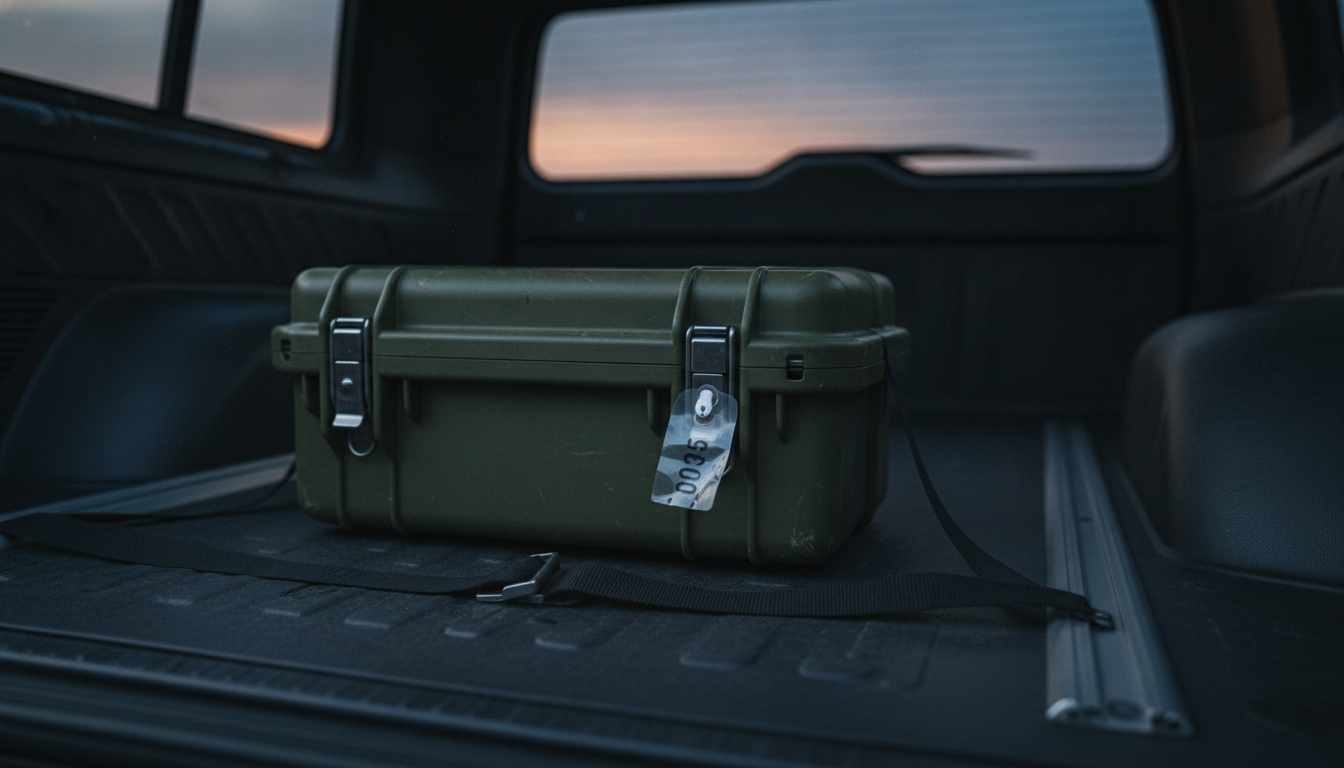
A scan event records what was scanned, who scanned it, when and where. The where is a GPS fix inside a geofence, in carGO Health’s case a 100-foot radius around the registered address. A photo of the sealed bags with the manifest visible is attached at pickup and delivery. Our medical courier proof of delivery page shows the capture sequence.
Five scan points cover a typical route: pack-out at the site, where the declared count is entered; pickup, where the courier scans each tote or bag barcode and the app flags any line not scanned; any transfer in transit, where the receiving driver re-scans; delivery, where receiving staff sign on the courier’s device; and accessioning, where the laboratory scans each tube into the LIS.
The two timestamps that matter most are pickup and accession. A pickup scan at 2:12pm and an accession scan at 5:40pm means 3 hours and 28 minutes in transit or at the dock; if the route plan said 90 minutes, something happened at the dock. Our guide to medical courier performance SLAs and KPIs turns that interval into a service measure, and the real-time medical delivery tracking page shows the live view between scans.
Minimum data for every scan event:
- Barcode scanned (manifest, tote seal or bag) and the result: matched, unmatched or missing
- Named handler, device timestamp, GPS fix and geofence result
- Declared count versus scanned count at that point, with the variance shown
- Photo of the sealed containers at pickup and at delivery
4. Count Discrepancies and the Missing-Specimen Protocol
Discrepancies fall into five types with different first moves. Short at pickup: nine declared, eight handed over; resolve at the door. Over at pickup: an unlisted bag appears; add it to the manifest with the site contact’s initials. Short at accessioning: counts matched at pickup but the bag arrived one tube light, so the loss happened in transit or the pack-out count was wrong. Mismatched: the count is right but a tube belongs to another patient. Damaged: present but leaking, hemolyzed or thawed.
A courier should not leave a site with an unresolved pickup discrepancy; the amended, initialed manifest becomes the baseline. Because the stability clock has been running since collection, the protocol starts the moment accessioning reports a short count. The laboratory notifies the courier within about an hour of receipt, and the courier runs an investigation time-boxed to roughly two hours: scan trail review, photo comparison, vehicle search, a site recount, and a check of other totes from the same route for a mis-sorted bag.
If nothing is found inside the time box, the laboratory decides on recollection and the ordering clinician is notified. The courier closes a nonconformance with a root cause category: pack-out count error, labeling error, transit loss, mis-sorted at the dock, or accessioning error. Our guides to pre-analytical errors in specimen handling and reducing specimen rejection rates through transport quality cover the laboratory-side corrective actions.
Missing-specimen protocol, in order:
- Accessioning reports the short count with manifest ID, bag ID and a description of the missing item
- Dispatch opens an investigation record and reviews scan events and photos within 15 minutes
- The driver is contacted and the vehicle searched; the sending site recounts; other totes from the route are checked
- At the two-hour mark the laboratory is given a finding and decides on recollection
- The nonconformance is closed with a root cause category and, where repeated, a corrective action
5. The Accessioning Handoff and the Data a Laboratory Should Receive
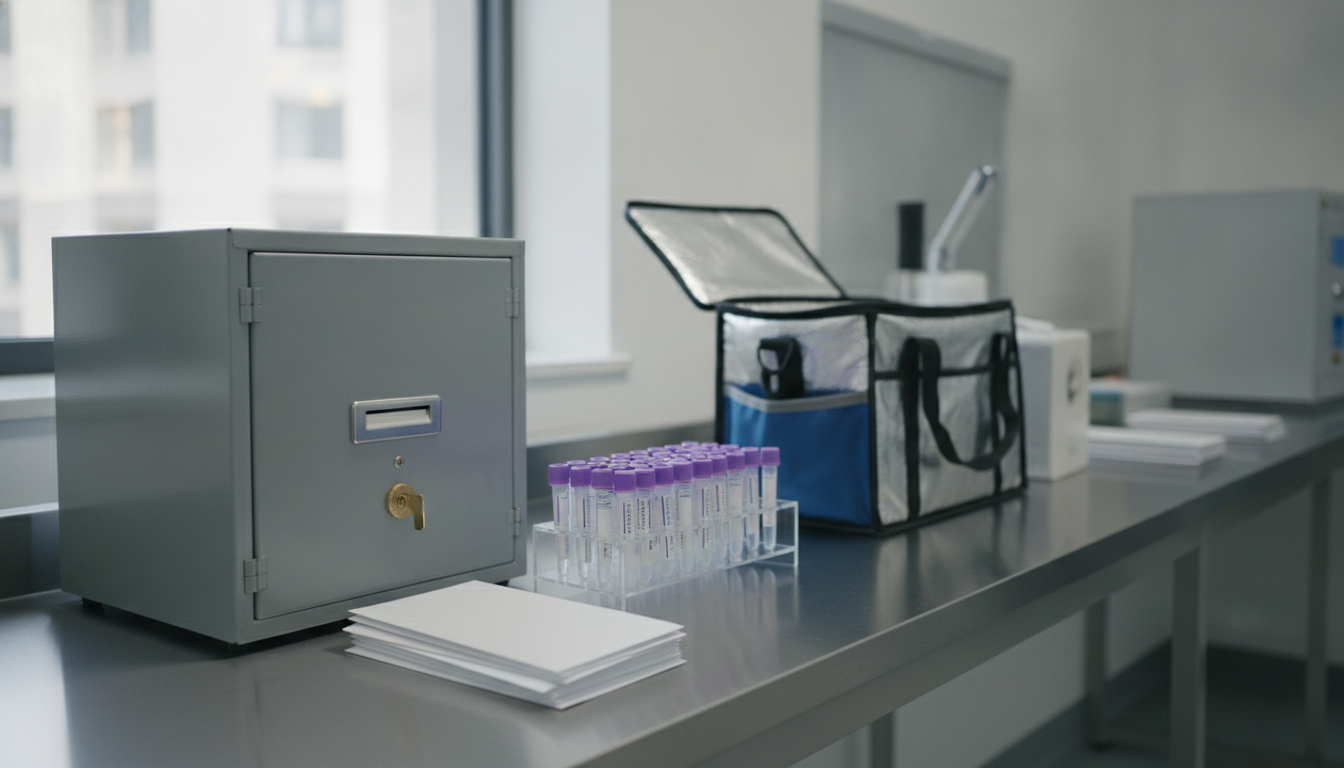
The handoff should happen at a staffed receiving point whenever specimens are irreplaceable or on a service clock: a named receiver, an e-signature on the courier’s device, an immediate check of cold packs and seals, and an exception logged on the spot. Drop boxes are acceptable for routine ambient work overnight if the box is temperature-controlled, the drop is photographed, and the morning scan closes the loop by a fixed time. The handoff is also where the two-identifier requirement in the Joint Commission National Patient Safety Goals is checked: the tube must match the requisition in the same bag.
After delivery the laboratory should receive a record it can reconcile against its LIS without re-keying. Per order: manifest ID, pickup and delivery timestamps, intermediate scans, named handlers, the GPS trail, photos at both ends, declared versus scanned counts at each point, any discrepancy with its resolution, and temperature data for cold legs. Per month: discrepancy rate by site and type, time to resolve missing-specimen reports, and pickup-to-accession intervals by site. The carGO Health platform exposes the per-order record in the customer portal and as an export, and the medical courier service for laboratories page describes the monthly review.
A regional example: a reference laboratory on Long Island receiving from several dozen patient service centers across Nassau and Suffolk counties. Bag-level scans at every center and a receiving window that scans totes in route order tie a short count to a route and a stop within minutes; coverage is on our Long Island medical courier service page. CLSI guidance on specimen collection and handling is the reference most laboratories cite when writing the receiving procedure.
Data elements to require in the courier agreement:
- Per-order scan history with handler, timestamp, GPS fix and photo at pickup and delivery
- Declared versus scanned count at every transfer point, with variance flagged
- A discrepancy log with type, time reported, time resolved and root cause
- Monthly site-level reports, delivered by export or API rather than email
Key Takeaways
Specimen manifest reconciliation is the count-level control that chain of custody does not provide. It depends on a manifest generated before the courier arrives, scan events at every transfer point, a discrepancy taxonomy that names the failed step, and a missing-specimen protocol measured in minutes rather than shifts.
- Reconcile at three levels: item counts at pack-out and accessioning, bag and tote counts at pickup and delivery
- Put tier, handling flags and declared count on every manifest line, and keep names off the courier-facing copy
- Resolve pickup discrepancies at the door; time-box accessioning discrepancies to about two hours
- Require per-order scan histories and monthly site-level discrepancy reports in the courier agreement
If your laboratory still reconciles courier deliveries from a clipboard, or cannot say which stop a missing tube came from, schedule a demo of the carGO Health platform to see how manifests, scan events and discrepancy records are configured for a multi-site laboratory.
Frequently Asked Questions
What is specimen manifest reconciliation?
Specimen manifest reconciliation is the comparison of the declared count of specimens on a manifest against the count actually scanned or found at each transfer point: pickup, any transfer in transit, delivery and accessioning. Its purpose is to detect a missing, extra or mismatched specimen at the earliest point, while it is still recoverable.
How is a manifest different from a chain of custody form?
A chain of custody form records who had possession of a sealed container and when, with signatures at each handoff. A manifest records what is inside: one line per bag with a declared item count, temperature tier and handling flags. Custody proves continuity of possession; the manifest proves completeness of contents.
What should a specimen manifest include?
A manifest identifier and barcode, generation time, origin and destination, one line per sealed bag with a requisition or accession number and declared item count, the temperature tier for each line, handling flags such as STAT or irreplaceable, and totals of bags per tote and totes per stop with seal numbers. Patient names and dates of birth stay inside the sealed bag.
What happens when a specimen count does not match the manifest?
At pickup, the discrepancy is resolved at the door and the manifest is amended with the site contact’s initials before the courier leaves. At accessioning, the laboratory reports the short count within about an hour and the courier runs a time-boxed investigation: scan review, photos, vehicle search and site recount. If nothing is found within about two hours, the laboratory decides on recollection.
What data should a laboratory receive from its courier after delivery?
For every order: manifest ID, pickup and delivery timestamps, all intermediate scans, named handlers, the GPS trail, photos at both ends, declared versus scanned counts at each point, any discrepancy and its resolution, and temperature data for cold legs. Monthly: discrepancy rates by site and type, time to resolve missing-specimen reports, and pickup-to-accession intervals by site.
Related Resources