Interfacility Medical Courier Logistics for Hospital Networks

A health system with six hospitals, two ambulatory surgery centers and forty practices has one laboratory that runs the esoteric menu, one transfusion service that holds the rare antigen-negative units and one pharmacy that compounds the chemotherapy. Everything else is a spoke. The material moving between those sites each day, specimens to the core laboratory, red cells to a hospital whose inventory is short, compounded syringes to an infusion center, is the circulation of the system, and an interfacility medical courier program is what carries it. When it slips, a transfusion service calls around for platelets and an infusion waits for a dose still sitting at the central pharmacy.
This guide is for health system logistics directors, core laboratory and outreach managers, transfusion service supervisors and pharmacy operations leads. It covers hub-and-spoke network design, what core laboratory consolidation moves and how fast, blood product transfers between facilities, pharmacy transfers, and the timetable and documentation that hold the program together.
1. Hub-and-Spoke Health Systems and the Interfacility Medical Courier
Consolidation created the interfacility problem. Health systems moved high-volume and esoteric testing into one core laboratory and left each hospital a rapid-response laboratory for the STAT menu: blood gases, basic chemistry, hematology, coagulation and point-of-care testing. Transfusion services centralized inventory with satellite blood banks at the spokes. Pharmacy built a central services center for sterile compounding and repackaging that feeds hospital pharmacies and infusion centers. Each move turned a corridor into a road, and the road has to run on a timetable the corridor never needed.
Designing the network starts with a map of flows rather than sites. Inbound flows carry specimens, tissue and records to the hub. Outbound flows carry blood products, compounded preparations and supplies to the spokes. Lateral flows move between spokes: a crossmatched unit following a transferred patient, a slide to a subspecialist. Each flow has an owner, a stability or beyond-use clock, operating hours at both ends and a volume pattern, and those four facts decide whether it rides a scheduled shuttle or a STAT run. Our medical courier service for hospitals page describes how flows are set up per site, and our guide to multi-site healthcare logistics coordination covers the governance that keeps six hospitals on one timetable.
Mapping the network before designing the routes:
- List every flow by origin, destination, contents and owner, not just every building
- Record the clock on each flow: analyte stability, product storage temperature, beyond-use date
- Record operating hours at both ends, including the core laboratory’s batch cutoffs
- Classify each flow as scheduled bulk, event-driven STAT or periodic, and size capacity for each
2. Core Laboratory Consolidation: What Travels and How Fast
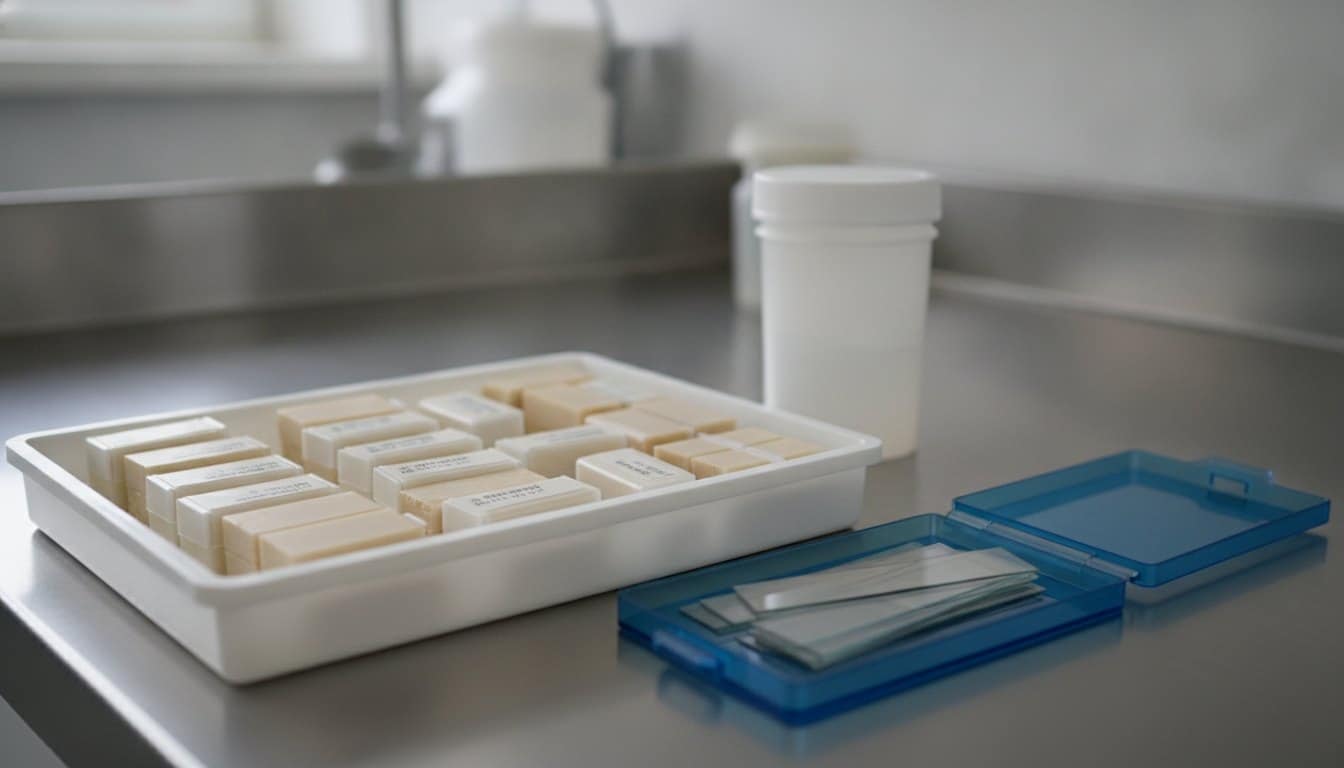
What travels from a hospital to the core laboratory is everything the rapid-response laboratory does not run: specialty chemistry and immunoassays, microbiology cultures, molecular testing, surgical pathology and cytology. What stays is governed by stability. Ammonia and lactate go on ice to the local bench within minutes; an activated partial thromboplastin time is limited to about 4 hours; whole blood for a complete blood count holds about 24 hours. The STAT menu at each spoke is really the list of analytes that cannot survive the shuttle, and that list should be written against published stability data rather than against habit.
The timetable follows. Specimens leave each hospital every 1 to 2 hours during the day, with the last run timed to the core laboratory’s evening batch and a night run for microbiology and overnight admissions. A loop that visits four hospitals before reaching the core adds 90 minutes to the first pickup, so shuttles should be point-to-point from the busiest sites and looped only where volumes are small. The metric is the pickup-to-accession interval by site, reconciled against manifest scans, and accreditation checklists from the College of American Pathologists expect transport conditions and timing to be documented for every specimen that crosses a road. Our guide to hospital courier services for health systems covers how that metric is reported.
Core laboratory shuttle design:
- STAT menu at each spoke defined by what cannot survive the shuttle, written against published stability data
- Departures every 1 to 2 hours by day, a last run timed to the evening batch, a night run for microbiology
- Point-to-point from high-volume hospitals; loops only for low-volume sites
- Pickup-to-accession interval tracked by site and reviewed with the laboratory monthly
3. Blood Product Transfers Between Facilities
Blood moves between hospitals for inventory balancing, for a crossmatched unit following a transferred patient, for rare antigen-negative units, for massive transfusion support and for platelets, whose shelf life of 5 to 7 days makes centralized inventory the only way to avoid outdating. The temperatures are fixed by standards from the Association for the Advancement of Blood and Biotherapies: red cells at 1 to 10 degrees Celsius during transport, platelets at 20 to 24 degrees Celsius, frozen plasma at or below minus 18 degrees Celsius and thawed plasma at 1 to 6 degrees Celsius, each in a validated shipping container with a documented hold time. FDA regulations at 21 CFR 600.15 govern temperatures during shipment and 21 CFR 606.165 governs distribution and receipt records; the FDA’s blood and biologics section is the authoritative reference.
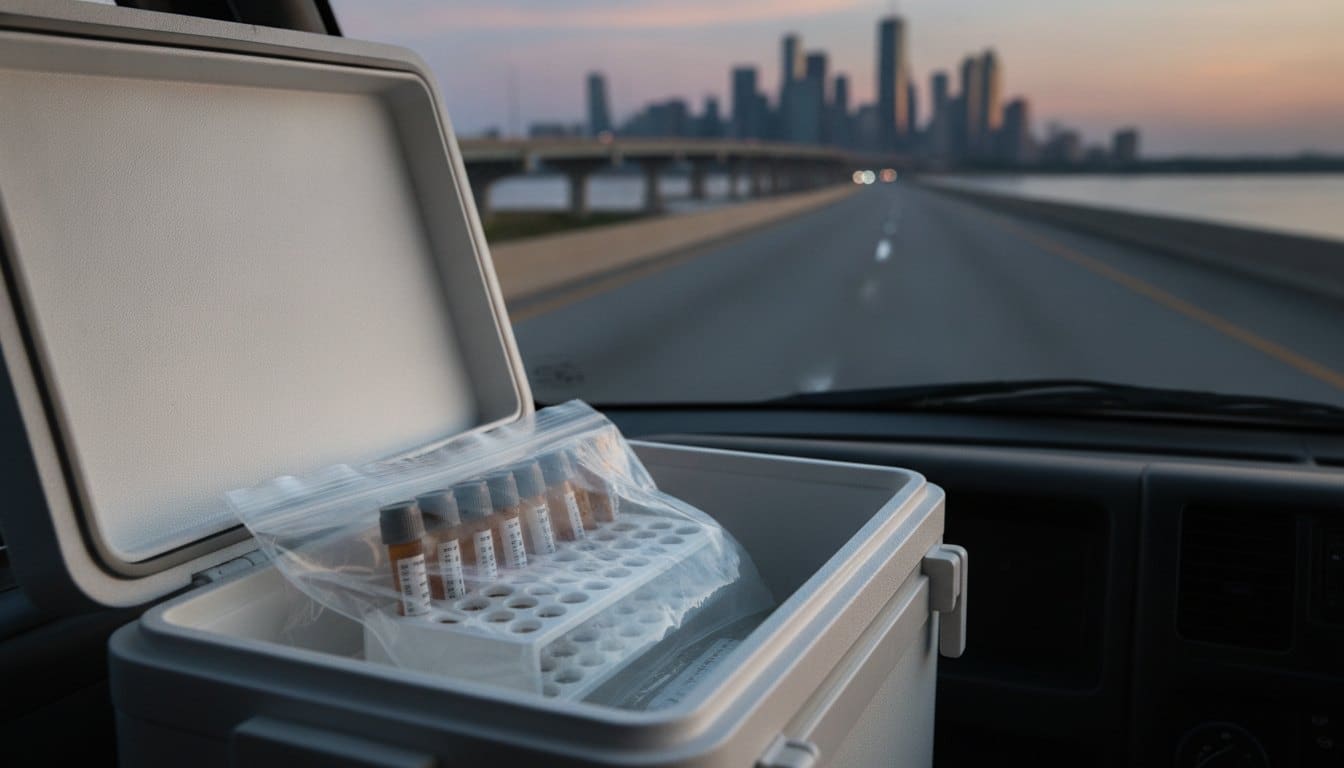
The record is as important as the temperature. Every transfer lists the unit numbers and product codes, expiration dates, the container’s departure time and temperature, the receiving time and temperature, and who packed and who received. A unit returned to inventory is accepted only if the container’s validated time and temperature are documented, which is why the sealed box is never opened in transit. The courier’s part is a direct run, a sealed container with a temperature indicator or logger, geofenced photo proof at both ends and an e-signature from transfusion service staff. Our blood product transport page describes the containers and our guide to blood bank courier services covers emergency release runs.
Transfer rules for blood components:
- Red cells 1 to 10 degrees Celsius, platelets 20 to 24, frozen plasma at or below minus 18, thawed plasma 1 to 6, in validated containers
- Transfer record with unit numbers, product codes, expiration, times and temperatures out and in, and names at both ends
- Sealed container, never opened in transit, direct run with no intervening stops
- Temperature indicator or logger inside, photo and e-signature from the receiving transfusion service
4. Pharmacy Transfers: Central Compounding, Cold Chain and Controlled Substances
A central pharmacy services center compounds sterile preparations under USP General Chapter 797 and ships them to hospitals and infusion centers against a beyond-use date that, for some categories, is measured in hours at room temperature and a day or two refrigerated. The delivery has to land inside that window with time for the pharmacist to verify and the nurse to administer, so the shuttle timetable is set against the first infusion chair of the morning and the chemotherapy re-dose in the afternoon. Hazardous drugs handled under USP General Chapter 800 travel in sealed, labeled containers with a spill kit in the vehicle. Refrigerated biologics and insulin ride at 2 to 8 degrees Celsius with a logger, following guidance from the American Society of Health-System Pharmacists on compounding and distribution.
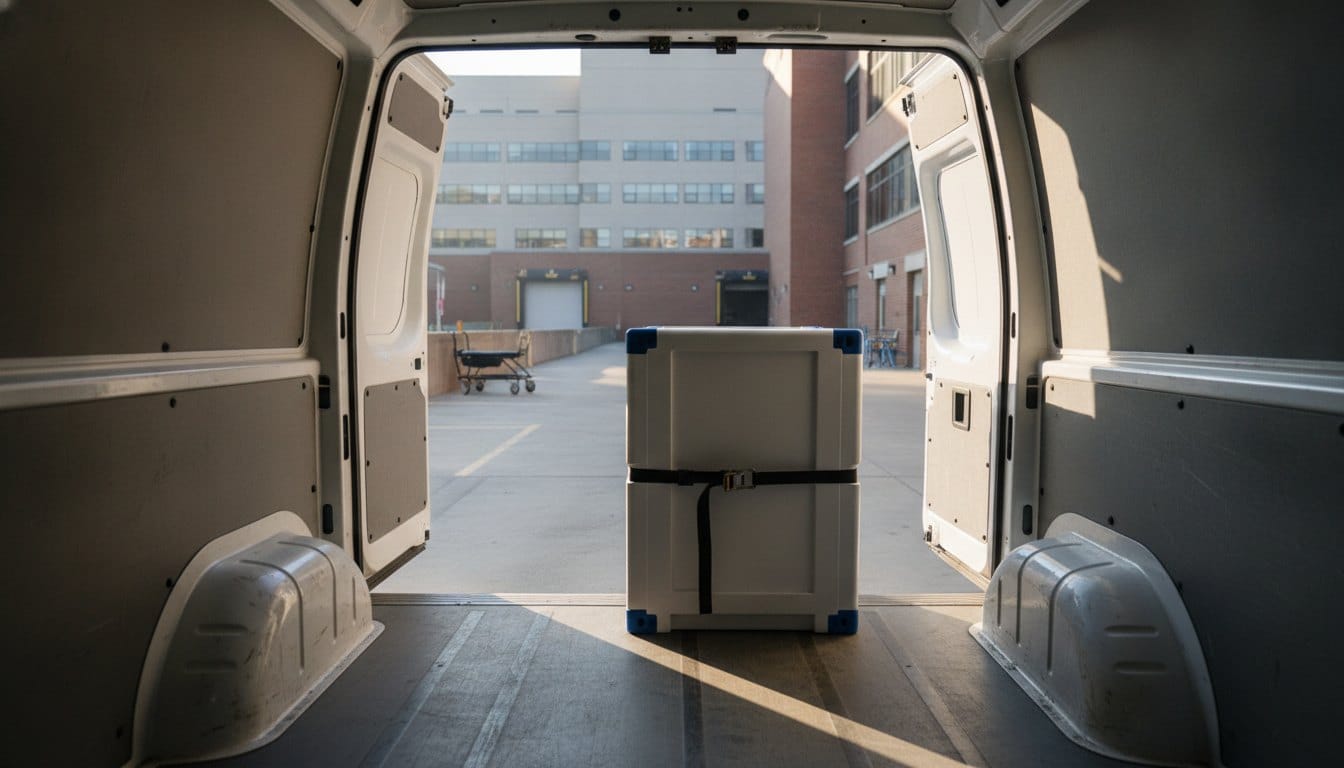
Controlled substances add a registration layer. Each hospital pharmacy is a separate Drug Enforcement Administration registrant, transfers between registrants are documented, and Schedule II transfers require the DEA order form. The courier never breaks a seal: controlled substances move in tamper-evident containers, counted and signed at pickup and at delivery, with chain of custody naming every handler and no intermediate stops. Emergency drug kit exchanges, automated dispensing cabinet restocks and after-hours STAT doses follow the same rules on a faster clock. Our pharmaceutical delivery service page describes how pharmacy runs are configured alongside laboratory shuttles on the same network.
Pharmacy transfer rules:
- Delivery timed inside the beyond-use date with verification and administration time to spare
- Hazardous drugs sealed and labeled, spill kit in the vehicle; refrigerated preparations at 2 to 8 degrees Celsius with a logger
- Controlled substances in tamper-evident containers, counted and signed at both ends, documented between registrants
- After-hours STAT doses and kit exchanges on a direct run with the same custody record
5. Scheduled Shuttles, STAT Overlay and the Documentation Trail
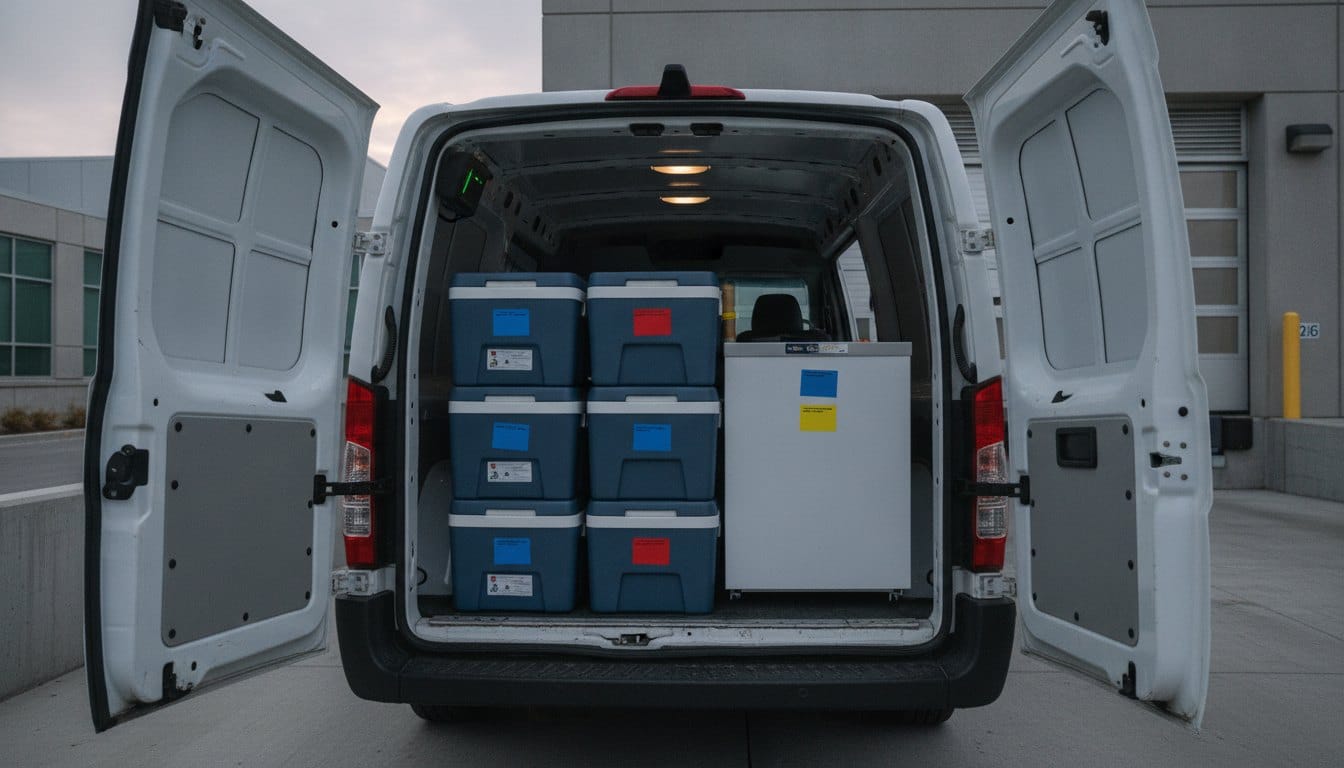
The timetable is a published shuttle schedule plus a STAT overlay, and the two must not blur. A shuttle departs each hospital at fixed minutes past the hour, runs point-to-point to the core and returns with blood products and pharmacy items, with frequency set by the shortest stability clock riding it. The STAT overlay has a written trigger list: emergency blood release, massive transfusion protocol, a STAT send-out the core must run tonight, a chemotherapy re-dose, a crossmatched unit following a transfer. Without the list, STAT becomes the default for anything that missed the shuttle. Our dedicated medical courier routes page describes the shuttle model and our STAT medical courier page the overlay; carGO Health runs both on one platform with 24/7 dispatch, AI-assisted sequencing and a floating driver network that absorbs the overlay without a van idling at each hospital.
Documentation is what survives an inspection. Every run produces a manifest listing each container by origin and destination, scan events at pickup and delivery, a geofenced photo, an e-signature, the temperature log attached to the order and a chain-of-custody record naming each handler. Manifests carry accession numbers rather than patient names wherever the laboratory information system allows. The Joint Commission standards expect specimen and medication handling to be documented, and the records that answer an inspector are time out, time in, temperature and who. Our medical courier proof of delivery page shows the record each run produces, and a three-hospital system in northern New Jersey is a typical shape: two spokes feeding a core, hourly shuttles by day, STAT overlay at night.
Timetable and documentation checklist:
- Published shuttle times by site, frequency set by the shortest stability clock on board
- Written STAT trigger list, reviewed quarterly against actual STAT volume
- Manifest, scan events, geofenced photo, e-signature and temperature log on every run
- Accession numbers rather than names on manifests; chain-of-custody record naming every handler
Key Takeaways
Interfacility medical courier logistics is the circulation of a consolidated health system. Map flows rather than sites, let stability and beyond-use clocks set the shuttle frequency, keep blood and controlled substances sealed on direct runs, and make every run produce a record an inspector can read.
- Core laboratory shuttles every 1 to 2 hours by day, point-to-point from busy hospitals, timed to the evening batch
- Blood components at their standard temperatures in validated containers with a full transfer record
- Pharmacy deliveries timed inside the beyond-use date; controlled substances sealed, counted and documented between registrants
- A published shuttle timetable plus a STAT overlay with a written trigger list
- Manifests, scans, photos, e-signatures and temperature logs on every run
If your health system is consolidating a laboratory, centralizing pharmacy compounding or rebalancing blood inventory across sites, schedule a demo of the carGO Health platform to see how shuttles, STAT overlays and transfer records are configured across a network.
Frequently Asked Questions
What is an interfacility medical courier?
An interfacility medical courier moves specimens, blood products, pharmacy preparations and records between the sites of one health system: from hospitals to a core laboratory, from a central transfusion service or pharmacy to the hospitals, and between hospitals. It runs on a published shuttle timetable with a STAT overlay, and every run produces a manifest, temperature log and chain-of-custody record.
How are blood products transported between hospitals in the same health system?
In validated shipping containers at the standard temperatures: red cells at 1 to 10 degrees Celsius, platelets at 20 to 24, frozen plasma at or below minus 18 and thawed plasma at 1 to 6. The container stays sealed on a direct run, carries a temperature indicator, and travels with a unit-level transfer record showing times, temperatures and names at both ends.
How often should specimens move from a hospital to a core laboratory?
Every 1 to 2 hours during the day from each hospital, with the last run timed to the core laboratory’s evening batch and a night run for microbiology and overnight admissions. The frequency is set by the shortest stability clock on board; anything that cannot survive the shuttle, such as an activated partial thromboplastin time beyond 4 hours, stays on the hospital’s STAT menu.
Can a courier transport controlled substances between hospital pharmacies?
Yes, within the rules that govern transfers between registered locations. Each hospital pharmacy is a separate DEA registrant, the transfer is documented between them, and Schedule II transfers use the DEA order form. The courier moves tamper-evident containers that are counted and signed at pickup and delivery, on a direct run with a chain-of-custody record naming every handler, and never opens a seal.
What documentation should an interfacility courier run produce?
A manifest listing each container by origin and destination, scan events at pickup and delivery, a geofenced photo at each end, an e-signature from the receiving staff, the temperature log attached to the order and a chain-of-custody record naming each handler. Blood transfers add the unit-level transfer record. Manifests should carry accession numbers rather than patient names wherever possible.
Related Resources