Biobank Sample Transport: Moving Research Specimens Intact

A clinical specimen is collected to answer one question about one patient. A biobank sample is collected to answer questions nobody has asked yet, years after the donor left the clinic. That difference changes everything about moving it. A thawed clinical tube is recollected tomorrow; a thawed research aliquot from a cohort enrolled in 2019 is gone. Biobank sample transport is therefore judged on a single criterion: the sample arrives in the same state, with the same identity and the same consent linkage, as it left.
This guide is for biorepository managers, research coordinators and biotech supply-chain leads. It covers the minus 80 and liquid nitrogen tiers, how dry shippers and dry ice boxes are prepared and monitored, how inventories and coded identifiers travel without protected health information, how material transfer agreements and research chain of custody divide responsibility, and how to plan the three kinds of move a biobank actually makes.
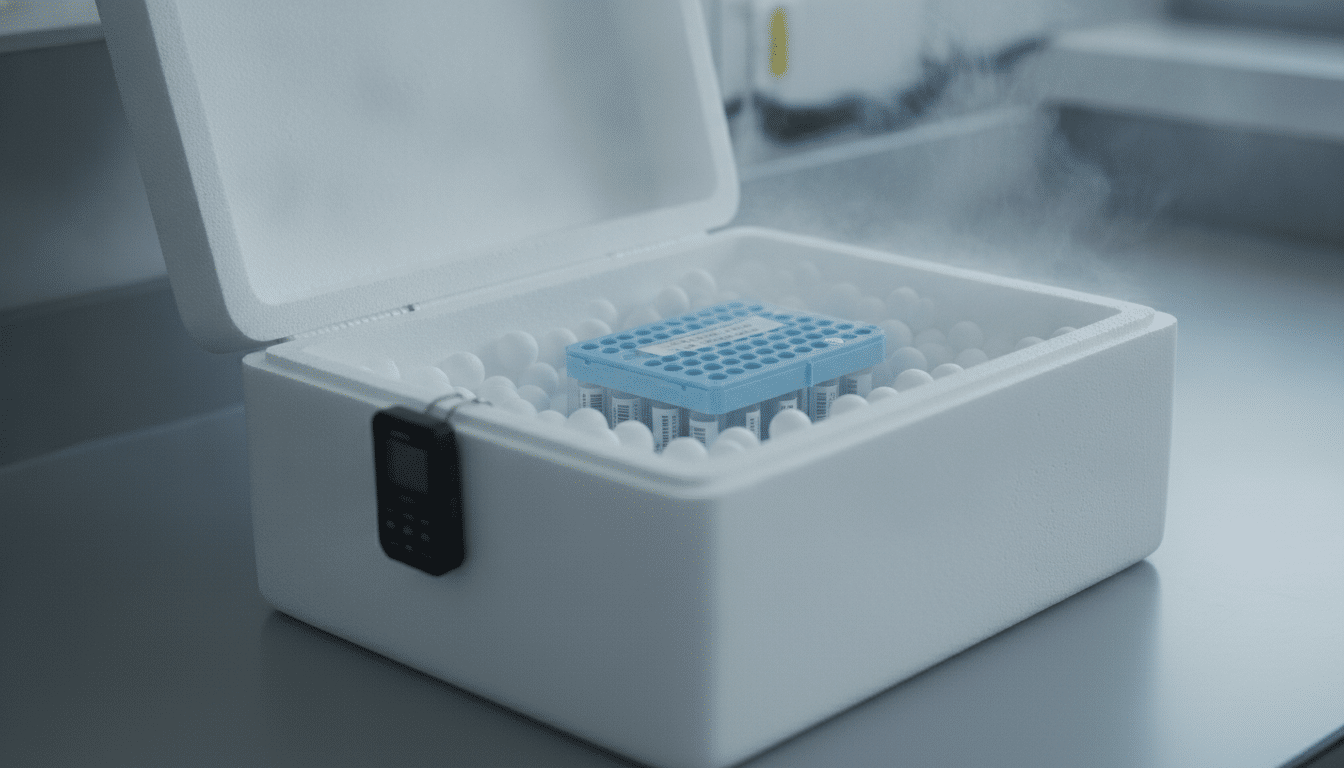
1. Temperature Tiers for Biobank Sample Transport: Minus 80 and Liquid Nitrogen
The transport tier must match the storage tier or be colder. Minus 80 degrees Celsius is the default for serum, plasma, urine, nucleic acid extracts and most tissue; in transit it is reproduced with dry ice, which holds the load near minus 78.5 degrees Celsius. Liquid nitrogen vapor phase, below minus 150 and typically near minus 190, is reserved for anything that must come back alive: PBMCs, cell lines, cord blood units, viable tissue for culture.
The damage mechanisms are specific. A minus 80 sample that warms to minus 20 for a few hours does not look thawed, but ice recrystallization has begun and RNA integrity drops. A cryopreserved cell vial that warms above about minus 130 degrees Celsius, even briefly, loses viability on thaw. Published work indexed by the National Library of Medicine on pre-analytical variability in biospecimens consistently names freeze-thaw cycles and time above storage temperature as the variables most often left uncontrolled.
Dry ice is a hazardous material for air transport (UN 1845) and must be packaged to vent carbon dioxide; by ground it is largely exempt but the venting requirement stands, as the PHMSA hazardous materials regulations set out. Our frozen specimen transport and cryogenic medical transport pages describe how the two tiers are ordered and equipped.
Tier selection by sample type:
- Serum, plasma, urine, nucleic acid extracts, snap-frozen tissue: minus 80, transported on dry ice
- Viable cells, cell lines, cord blood, tissue for culture: liquid nitrogen vapor in a dry shipper
- Fresh tissue in media, whole blood for PBMC isolation: 2 to 8 degrees Celsius or ambient, within hours
- Never a warmer tier in transit than in storage, and never a freeze-thaw to change containers
2. Dry Shippers and Dry Ice Boxes: Preparation, Hold Time and Monitoring
A dry shipper is a vacuum-insulated dewar whose inner wall is lined with absorbent that soaks up liquid nitrogen, so the cavity sits in cryogenic vapor with no free liquid. The shipper is filled in stages over roughly 24 hours until the absorbent is saturated, then all free liquid is poured off. The manufacturer’s static hold time, often 7 to 21 days, assumes a full charge, an upright shipper and a closed lid. A tipped shipper loses hold time fast, so a tip indicator and a cavity logger are standard. Properly prepared, with no free liquid, a dry shipper is not regulated as a dangerous good in air transport under the IATA Dangerous Goods Regulations.
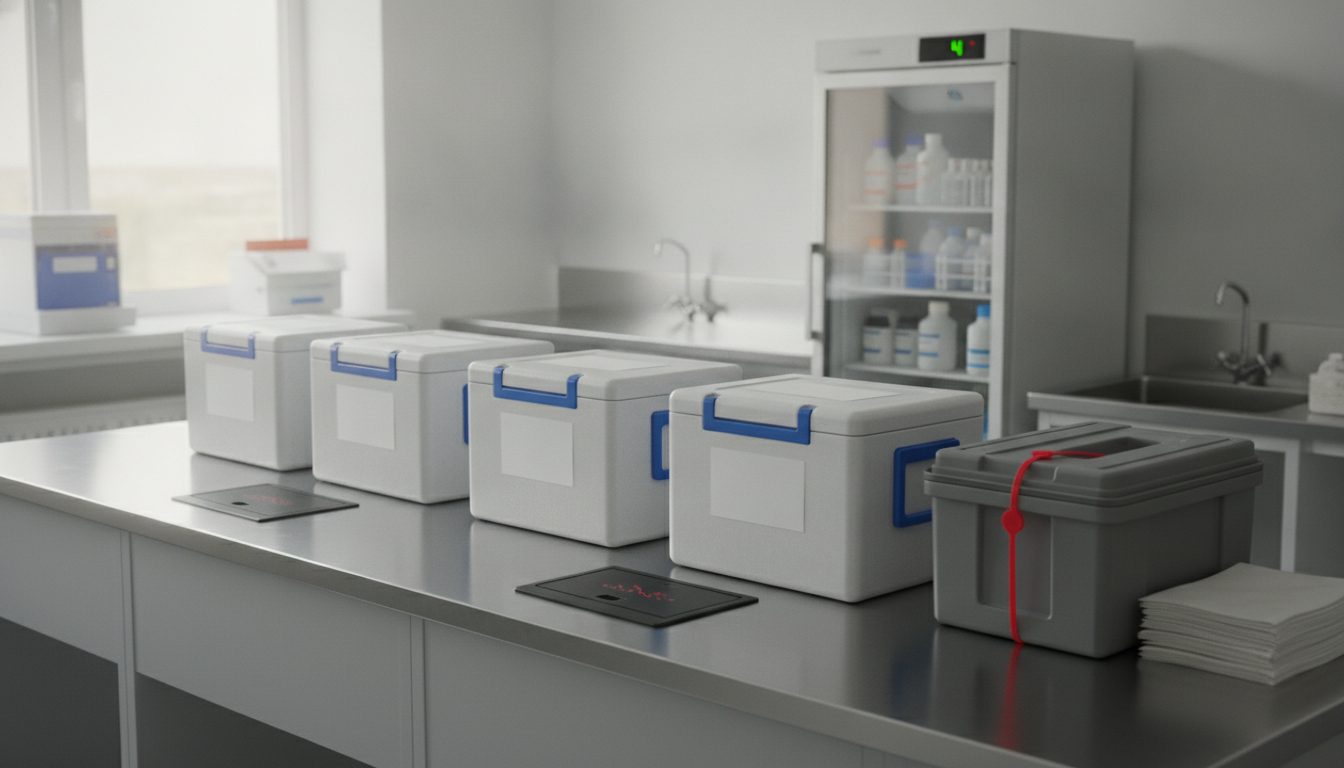
Dry ice boxes are simpler and less forgiving. Sublimation runs at roughly 5 to 10 pounds per 24 hours in a typical insulated shipper, so the box is packed for at least twice the expected transit time and never sealed airtight. Pellets below, around and above the cryoboxes keep the center cold, and the logger probe goes in the sample layer with a range that reads to minus 80. Our guide to IoT temperature monitoring for medical couriers compares logger options for both tiers, and the dry ice medical shipping page covers how carGO Health sizes and tops up dry ice on ground routes.
Preparation and acceptance checks:
- Dry shipper charged over about 24 hours, free liquid decanted, charged weight recorded
- Hold time confirmed against the planned transit with margin; tip indicator and cavity logger fitted
- Dry ice box packed for at least twice the transit time, pellets around every cryobox, lid vented
- At receipt: dry ice remaining or shipper weight, logger minimum and maximum, seal and tip status
3. Sample Inventories, Identifiers and Consent Linkage Without PHI
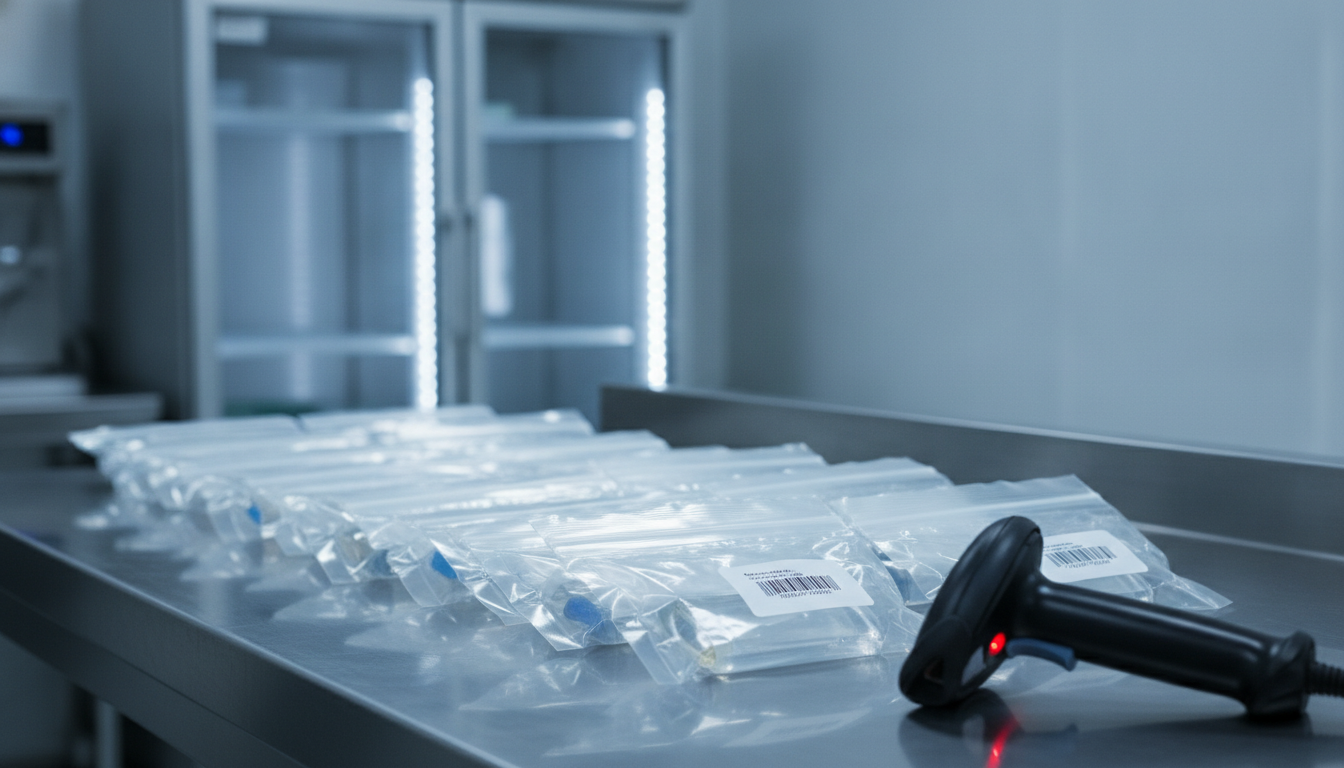
A biobank’s inventory maps each physical vial to everything known about it: donor code, collection date, sample type, aliquot number, freeze-thaw count and storage position down to box, row and column. The transport manifest is a slice of that inventory: box identifiers, each with its sample identifiers and positions, the storage tier, and aliquot type and volume. Each cryovial carries a 2D barcode, and the manifest is generated from the biobank information management system rather than typed, so boxes are scanned against an existing inventory at pickup and positions on arrival.
None of that is protected health information if the identifiers are coded. The sample identifier is a research code; the key linking it to a donor is held by the biobank or an honest broker and never travels with the samples. The HIPAA de-identification standard and the research protections at 45 CFR 46, overseen by the HHS Office for Human Research Protections, govern how consent and identifiability are handled. The courier-facing manifest therefore carries codes, box IDs, tiers and counts, and nothing that identifies a donor.
Consent linkage is why the coding must be reliable, not merely private. A donor who withdraws consent is entitled to have every aliquot located and destroyed, which is only possible if each vial’s position and identifier survived every move. Consent scope travels as an inventory flag, and the recipient’s permitted use is checked against it before release. Our guide to clinical trial specimen transport requirements covers the parallel rules for sponsor-owned samples.
What the transport manifest carries, and what it does not:
- Box identifiers with sample identifiers and positions, generated from the biobank system
- Storage tier, aliquot type and volume per sample, and the current freeze-thaw count
- A consent scope flag that the receiving use was checked against before release
- No names, dates of birth, medical record numbers or any direct identifier
4. Material Transfer Agreements and Chain of Custody for Research
A material transfer agreement is the contract under which one institution provides samples to another. It names provider and recipient, describes the material, states the permitted use, prohibits attempts to re-identify donors, restricts onward transfer, addresses publication and intellectual property, and sets what happens when the work ends: return, destruction or continued storage. It also allocates shipping responsibility: who packs, pays and bears the loss. The National Institutes of Health publishes model agreements and sharing policies that most academic biobanks adapt. The agreement governs the legal transfer; it does not document the physical one.
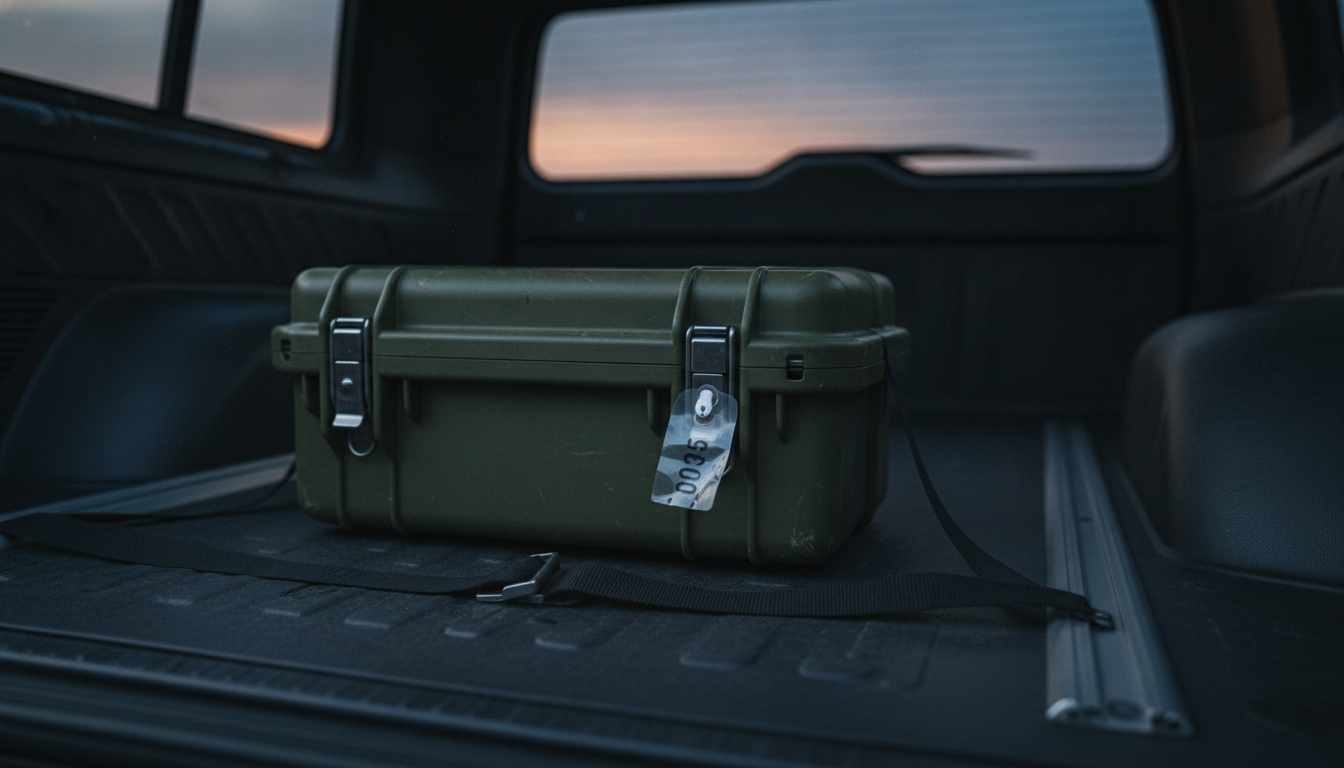
That is the job of research chain of custody. It matters because a reviewer, auditor or inspector may ask, years later, where a sample was on a particular afternoon. The courier’s record is: a geofenced pickup scan of each box or shipper barcode against the manifest, photographs of the sealed shippers with seal numbers visible, logger identifiers recorded at pickup, every handoff named and timed, and an e-signature from the receiving biobank with the dry ice or shipper weight and logger minimum and maximum. Our guide to chain of custody in medical specimen transport covers the general mechanics.
The two documents meet at release. The biobank releases nothing until the agreement is executed, the permitted use is checked against consent scope, and the manifest is generated from inventory. The courier does not leave until the box count matches and the seals are photographed.
Custody record for a research shipment:
- Executed material transfer agreement reference and release approval on the order
- Box or shipper barcodes scanned against the manifest inside the pickup geofence
- Photographs of sealed shippers with seal numbers and logger serials visible
- Receipt e-signature with dry ice remaining or shipper weight, logger minimum and maximum, and box-level reconciliation
5. Planning the Three Kinds of Biobank Sample Transport
Biobanks make three kinds of move, and each needs a different service. The first is the inbound collection run: fresh samples from clinical sites to the processing laboratory, where blood for PBMC isolation must arrive ambient within about 8 to 24 hours of draw, fresh tissue in media at 2 to 8 degrees Celsius within hours. These are scheduled routes or same-day orders timed to the processing bench rather than the clinic’s convenience.
The second is the freezer-to-freezer bulk transfer: a relocation, consolidation or change of custodian. Thousands of vials move in box-level manifests across multiple shippers, sequenced freezer by freezer so that each receiving freezer is pre-cooled and its capacity validated before its boxes leave the origin. The plan limits bench exposure per box to a minute or two, assigns a logger to every shipper, and reconciles box count at receipt before the next vehicle is loaded. A regional example is an academic repository moving between facilities in the Boston area, where the freezers at both ends, not the road, are the constraint; coverage is on our Boston medical courier service page.
The third is distribution: a few boxes of aliquots to an investigator or a biotech partner under a material transfer agreement. carGO Health serves all three on the same platform: scheduled routes for collection runs, project-managed moves for bulk transfers, and on-demand same-day orders for distribution. The medical courier service for biotech page and our guide to biotech and pharmaceutical supply chain logistics describe how distribution runs are coordinated with the receiving laboratory’s schedule.
Planning questions for each move type:
- Collection runs: what is the processing deadline from draw, and which tier gets the sample there intact
- Bulk transfers: how many boxes per shipper, how many shippers per vehicle, and in what freezer order
- Bulk transfers: is the receiving freezer pre-cooled, validated and mapped before the first box leaves
- Distribution: is the agreement executed, the consent scope checked, and the recipient’s run scheduled
Key Takeaways
Biobank sample transport is judged on whether the sample arrives in the same state, with the same identity and the same consent linkage, as it left. That depends on matching the transport tier to the storage tier, preparing dry shippers and dry ice boxes with margin, moving coded inventories rather than names, and pairing the material transfer agreement with a custody record a reviewer can read years later.
- Minus 80 samples travel on dry ice; viable cells travel in liquid nitrogen vapor in a dry shipper; never a warmer tier in transit than in storage
- Generate manifests from the biobank inventory with coded identifiers, positions, tier and consent scope, and no PHI
- Release only against an executed material transfer agreement; reconcile box counts and seals at pickup and receipt
- Plan collection runs, bulk transfers and distributions as three different services on one custody standard
If your repository is planning a freezer move, onboarding new collection sites or distributing aliquots under agreement, request a demo of the carGO Health platform to see how tiers, loggers, box-level manifests and custody records are configured for research shipments.
Frequently Asked Questions
What temperature should biobank samples be transported at?
At the storage tier or colder. Serum, plasma, urine, nucleic acid extracts and snap-frozen tissue stored at minus 80 degrees Celsius travel on dry ice, which holds about minus 78.5. Viable cells, cell lines and cord blood travel in liquid nitrogen vapor below minus 150 degrees Celsius in a dry shipper.
How does a liquid nitrogen dry shipper work?
A dry shipper is a vacuum-insulated dewar lined with absorbent that soaks up liquid nitrogen, so the sample cavity sits in cryogenic vapor with no free liquid to spill. It is charged in stages over about 24 hours, the free liquid is poured off. Kept upright and closed, common sizes hold temperature for roughly 7 to 21 days.
How much dry ice is needed to ship frozen research samples?
Enough to last at least twice the expected transit time, allowing for sublimation of roughly 5 to 10 pounds per 24 hours in a typical insulated shipper. Pellets are packed below, around and above the cryoboxes, the lid is left able to vent carbon dioxide, and the receiver records the dry ice remaining at delivery.
Can biobank samples be shipped without protected health information?
Yes, and they should be. The manifest carries coded sample identifiers, box identifiers and positions, tier, aliquot type and a consent scope flag, all generated from the biobank information system. The key linking codes to donors stays with the biobank or an honest broker. No names, dates of birth or medical record numbers travel with the shipment.
What is a material transfer agreement and when is it needed?
A material transfer agreement is the contract between a providing institution and a recipient that defines the material, the permitted research use, restrictions on re-identification and onward transfer, shipping responsibility, and what happens to the material when the work ends. It is needed whenever samples move between institutions, and the shipment should not be released until it is executed.
Related Resources