Winter Medical Courier Operations: Snow, Ice and Contingency Routing
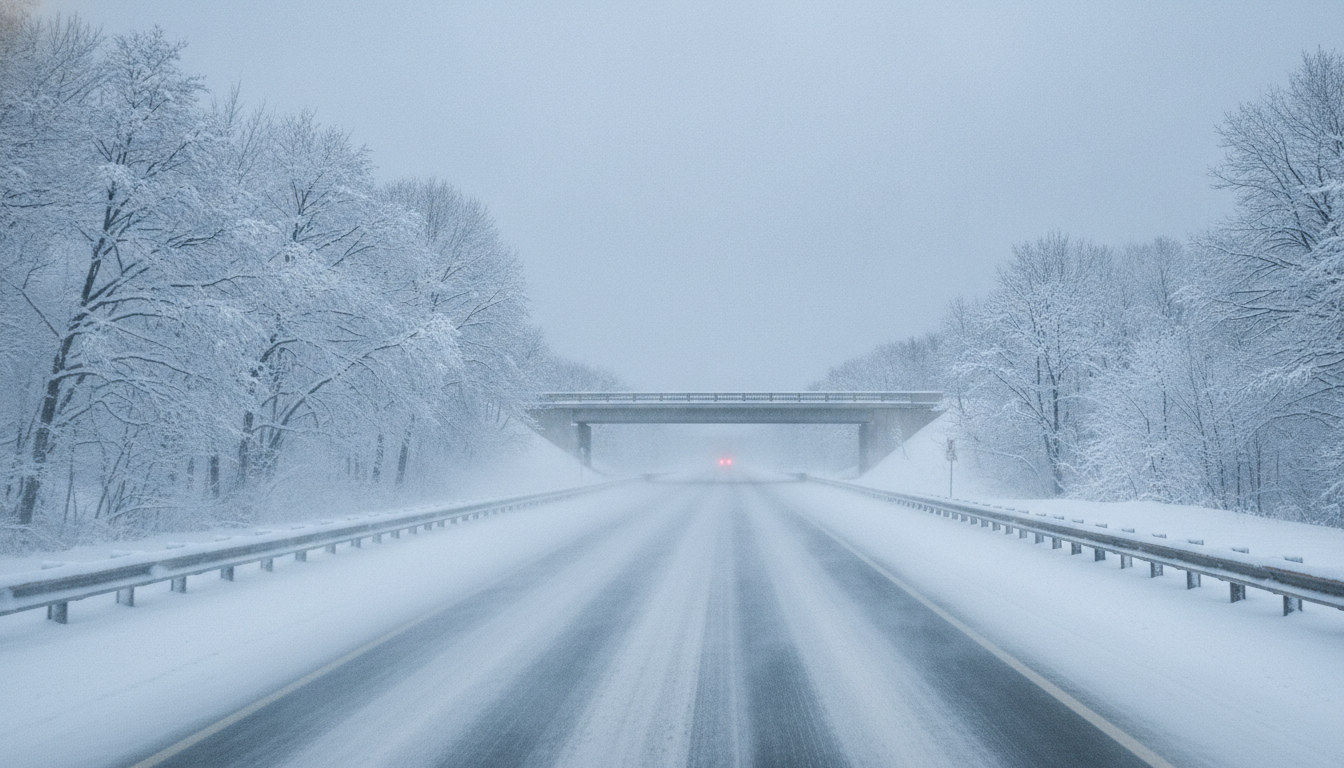
A nor’easter does not cancel a chemotherapy infusion, a STAT potassium or a platelet transfusion. Between December and March, every laboratory and hospital in the Northeast runs a logistics program whose assumptions were written in September, and the first 8 inch snowfall tests all of them at once. Winter medical courier operations are the discipline of deciding, before the forecast turns, what moves, what waits at the source, which routes change shape and how the laboratory hears about it.
This guide is for laboratory directors, hospital logistics managers and pharmacy operations leads across the ten Northeast states we serve. It covers the storm playbook, vehicle and container readiness, specimen stability when roads close, laboratory communication, and the pre-positioning decision that separates a delayed route from a lost day.
1. The Storm Playbook Behind Winter Medical Courier Operations
A storm playbook is a set of triggers tied to actions, not a memo that says “use caution.” The cleanest triggers are National Weather Service products. A winter storm watch means hazardous conditions are possible and usually arrives a day or more ahead. A winter storm warning or blizzard warning means the event is expected, on a shorter horizon. An ice storm warning stops a region, because a quarter inch of glaze defeats tires, power lines and traffic signals at once.
State governments add a second layer. Governors across the region have ordered travel bans during major storms, sometimes with a few hours of notice. Medical transport is commonly treated as essential, but the exemptions vary by state and by order. Every vehicle should carry a document stating that the run carries medical specimens or blood products, the order number and a dispatcher who answers around the clock to confirm it. OSHA’s winter weather guidance covers the hazards of driving and working in snow and extreme cold, and the tiers below should be built with it in mind.
Playbook tiers and the actions each one releases:
- Tier 1, watch issued: confirm client priority lists, check gel pack, phase-change pack and dry ice inventory, confirm driver availability, fuel every vehicle
- Tier 2, warning issued: compress scheduled routes, move afternoon pickups earlier, confirm hold rules with laboratories, pre-position capacity near hospital hubs
- Tier 3, storm in progress or travel restriction: STAT-only operations, hold-at-source for stable specimens, continuous monitoring of every active order
- Tier 4, recovery: a priority sweep ordered by specimen stability and clinical urgency, then manifest reconciliation and a timestamped delay report for each client
2. Vehicle and Container Readiness for Winter Medical Courier Operations
Vehicle readiness decides whether a route finishes. Winter tires outperform all-season tires once sustained temperatures fall below roughly 7 degrees Celsius. A battery that starts a car at 20 degrees Celsius can fail at minus 15, so load-test batteries in November. Washer fluid rated to minus 30 degrees Celsius, a full tank at the start of every storm shift, a shovel, traction mats and a phone power bank belong in every vehicle on a winter roster.
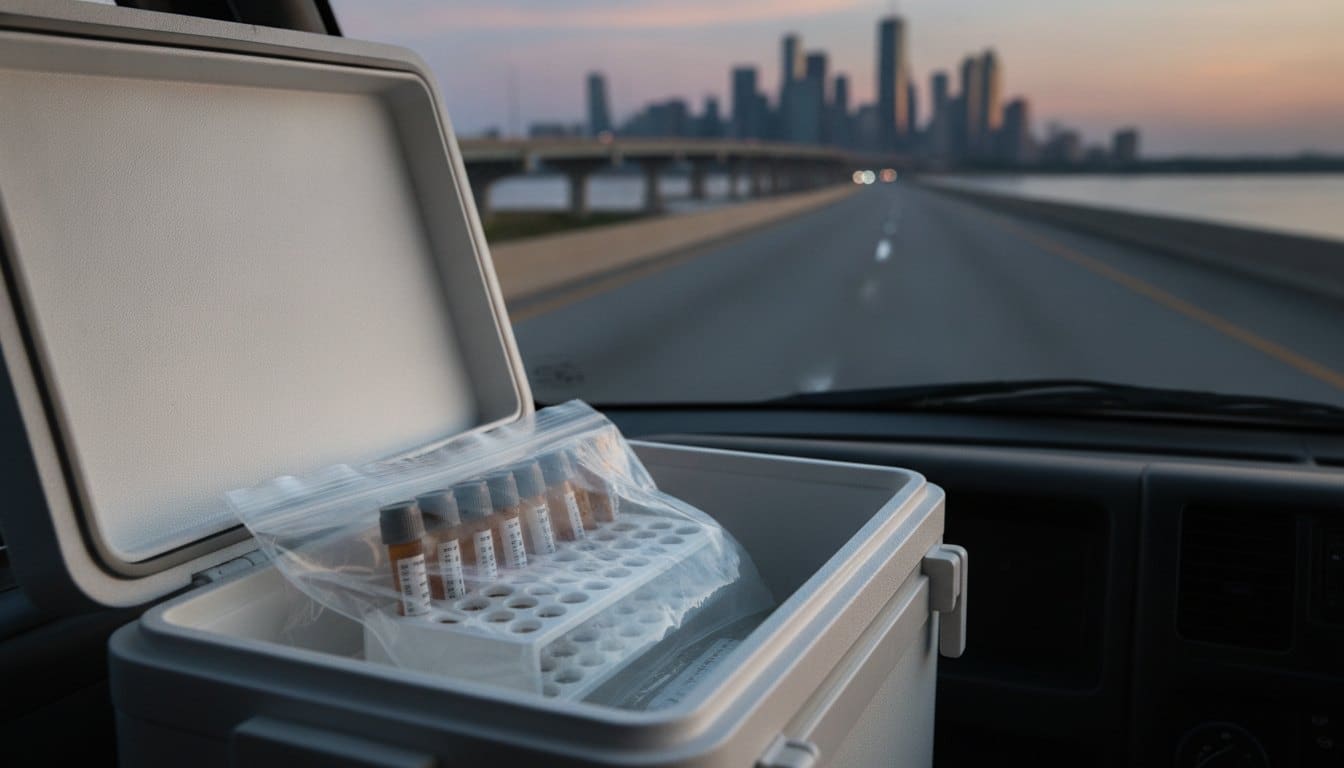
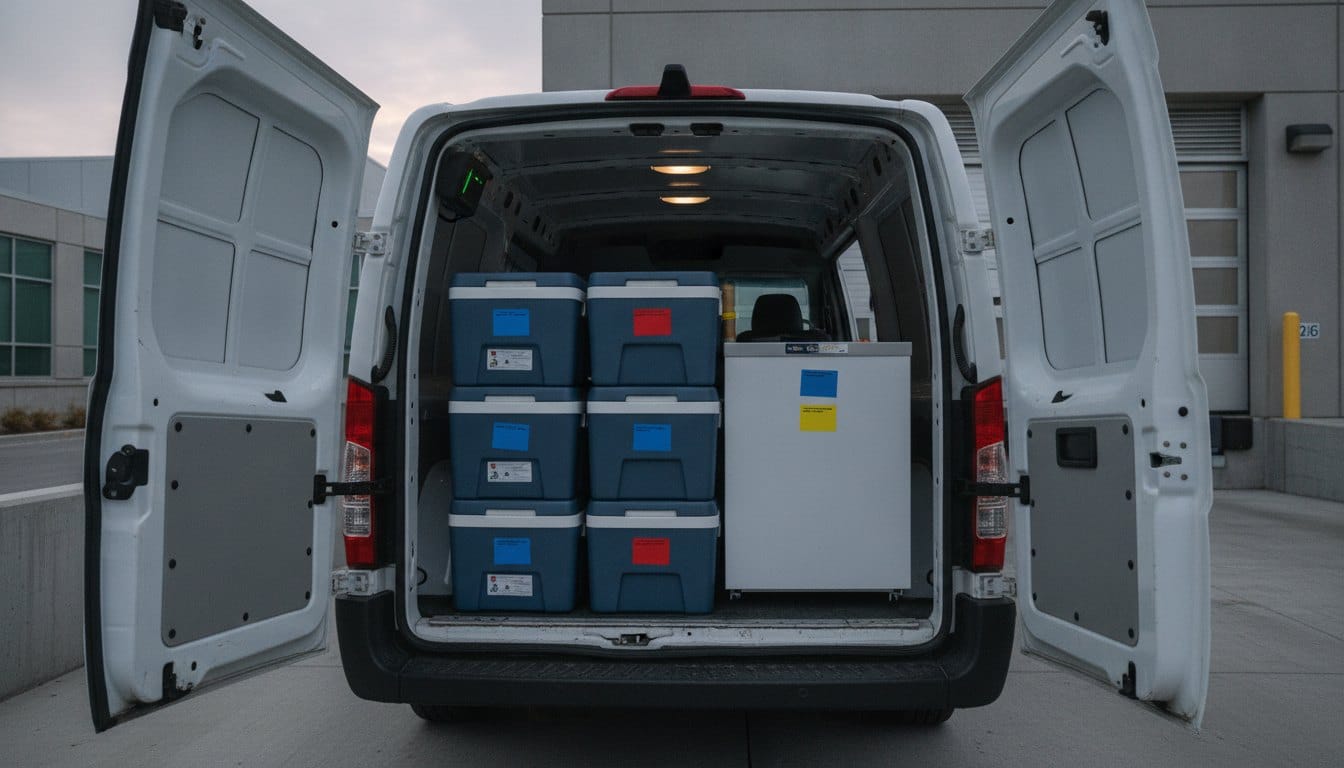
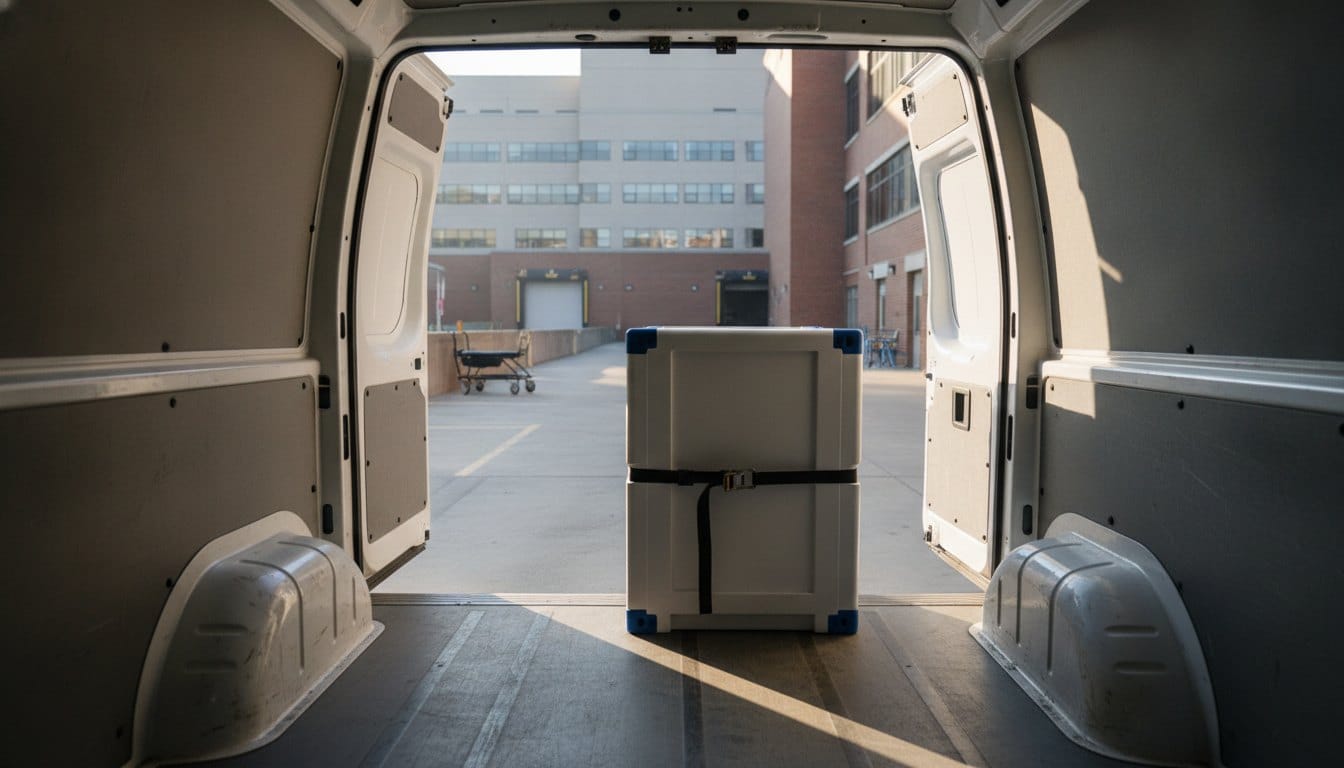
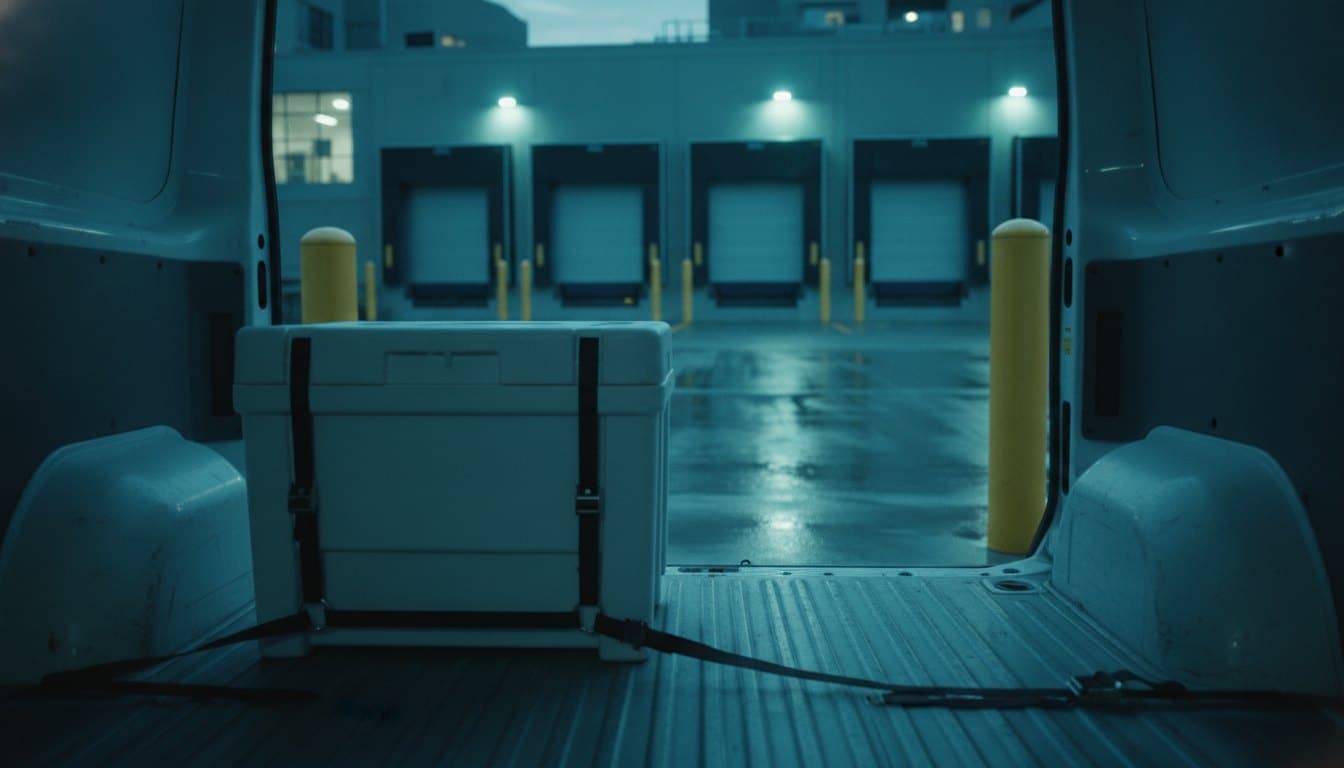
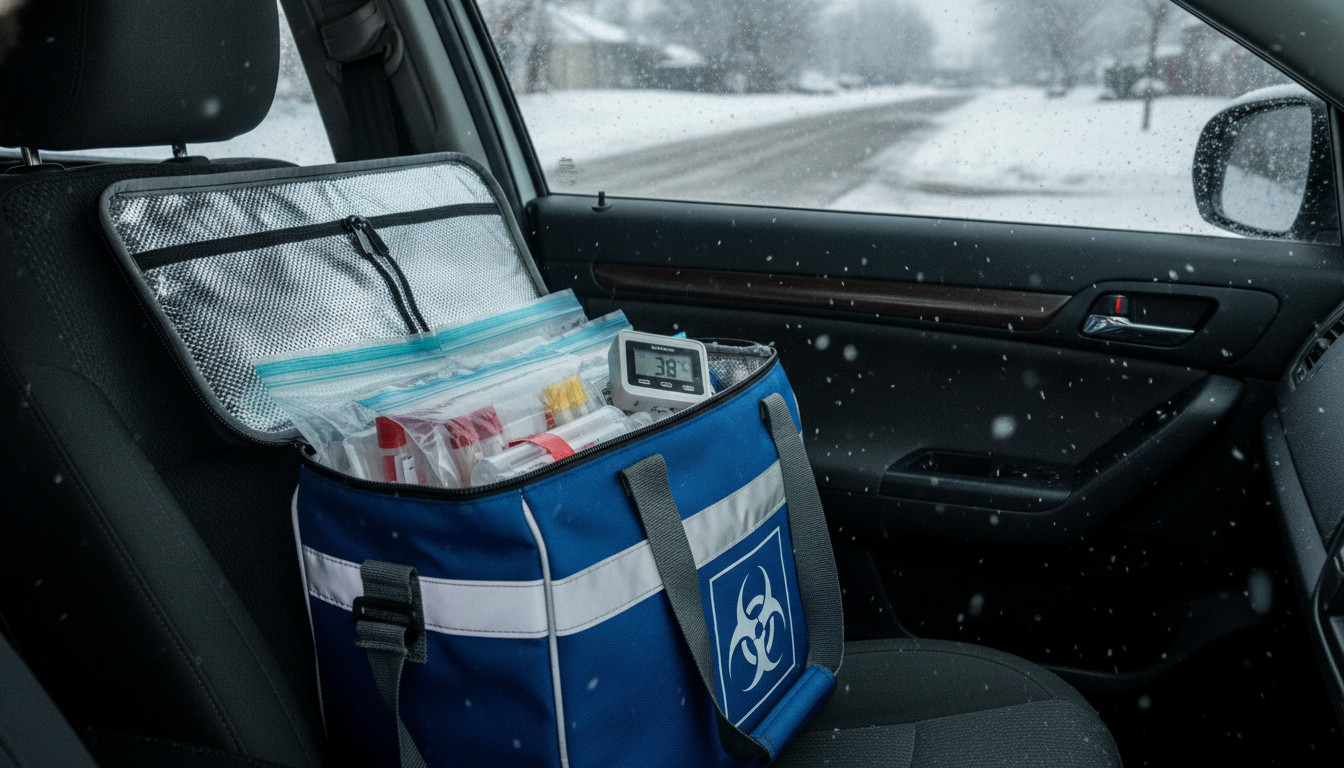
A vehicle cabin is not a temperature tier. An unheated cabin in a minus 10 degree Celsius storm falls toward freezing quickly once the engine is off. Ambient means 15 to 25 degrees Celsius, held in an insulated tote with phase-change packs conditioned near 22 degrees Celsius. In winter the refrigerated tier flips its usual risk: a 2 to 8 degree Celsius tote packed with several gel packs can drop below zero in a cold cabin, so pack fewer conditioned packs and put a data logger inside; our temperature-controlled medical transport page describes each tier. Standards from the Association for the Advancement of Blood and Biotherapies set red cells at 1 to 10 degrees Celsius in transit and platelets at 20 to 24, so a platelet box in January needs insulation against cold rather than heat. Continuous logging, covered in our guide to temperature monitoring with IoT sensors, turns a storm delay into a documented excursion or a documented non-event.
Winter readiness checklist by vehicle and container:
- Winter or all-weather tires, battery load test, washer fluid rated to minus 30 degrees Celsius, full tank before every storm shift
- Shovel, traction mats, blanket, headlamp, power bank and a printed essential-transport document in every vehicle
- Ambient totes with phase-change packs near 22 degrees Celsius; totes ride in the heated cabin, never the trunk
- Refrigerated totes with fewer gel packs and a logger; platelets insulated to hold 20 to 24 degrees Celsius; extra dry ice for frozen material
3. Specimen Stability When Roads Close
When a road closes, the question is not whether the courier can get through but whether the specimen will still be valid when it does. EDTA whole blood for a complete blood count is commonly accepted for about 24 hours at room temperature. Citrated blood for a prothrombin time is accepted up to 24 hours by most laboratories, while an activated partial thromboplastin time is generally limited to about 4 hours. Blood culture bottles stay at room temperature and are never refrigerated; unpreserved urine for culture is refrigerated and plated within 24 hours. CLSI guidelines are where most laboratories anchor these windows.
Those windows produce a hold-at-source rule: if dispatch cannot forecast delivery inside the window, the specimen is safer in the collection site’s refrigerator or on its counter than in a vehicle stopped on an interstate. The portal order carries a flag at placement, hold if delivery cannot be completed within a stated number of hours, with the holding temperature. Whole blood drawn for potassium is held at room temperature, because cold shifts potassium out of red cells and produces a falsely high result. Winter’s failure mode is freezing, not heat: frozen whole blood hemolyzes and frozen urine loses its microscopy. Studies indexed by the National Library of Medicine have consistently reported that most laboratory errors arise in the pre-analytical phase; our guide to pre-analytical errors in specimen handling lays out the rest.
Stability rules that decide dispatch versus hold:
- Publish a signed stability list by specimen type, with ambient and refrigerated windows, before the first storm of the season
- Add a hold-if-delayed flag to portal orders, with the holding temperature stated for each specimen type
- Never refrigerate whole blood for potassium, blood culture bottles or cerebrospinal fluid for bacterial culture; hold them at room temperature
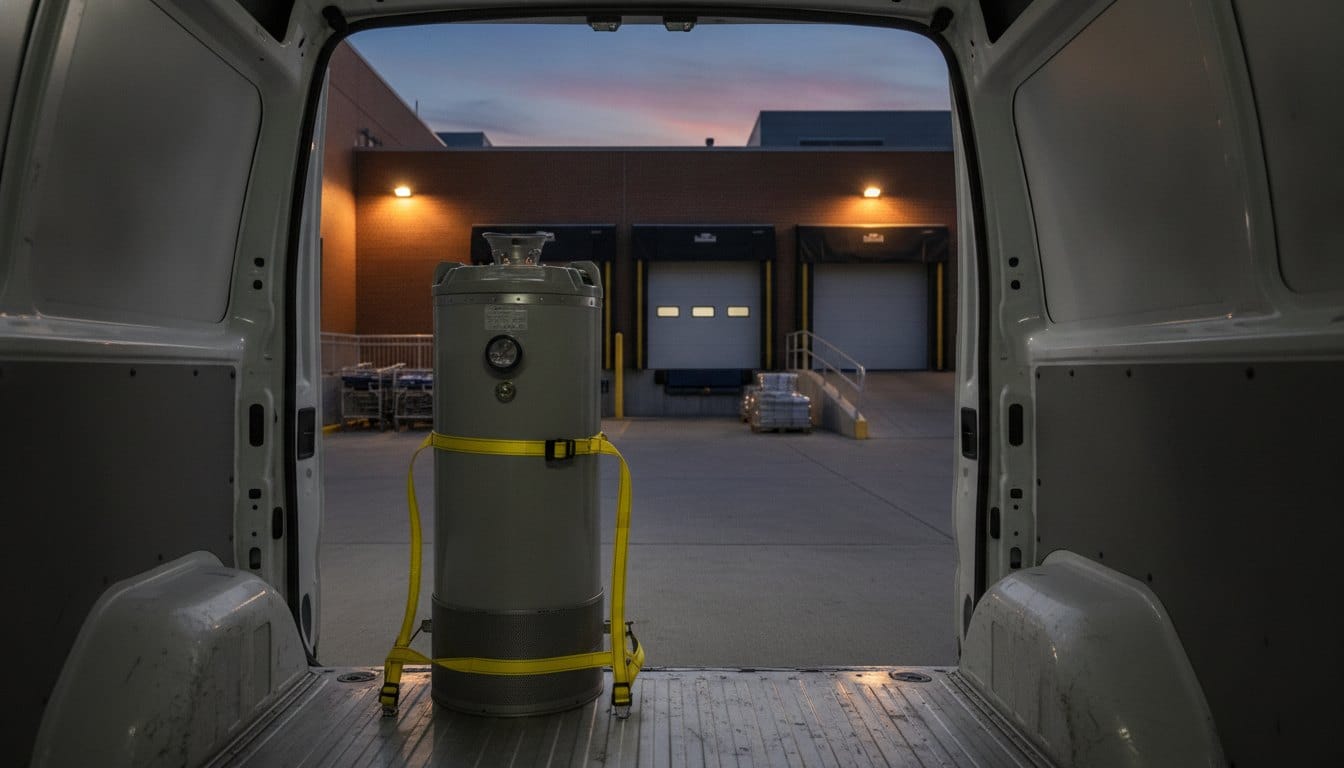
- Move frozen and cryogenic material only when the full route is confirmed open, with extra dry ice or a freshly charged dry shipper
4. Laboratory and Client Communication During a Storm
A laboratory that learns about a delay from silence will not trust the next storm notice. Before the storm, 24 to 48 hours ahead, each client receives a short notice stating what changes, what does not and whom to call: scheduled routes compressed, the last pickup moved from 5:00pm to 3:00pm, STAT service unchanged around the clock, and the specimen types that will be held at source if roads close.
During the storm, the laboratory should never need to call for an ETA. Live GPS tracking, geofenced pickup and delivery photos and order status in the portal answer the question first; the mechanics are on our real-time medical delivery tracking page. What the laboratory does need is a human decision when an order will miss its window: dispatch calls, proposes hold or reroute, and records the answer on the order. That record matters, because accreditation checklists published by the College of American Pathologists expect laboratories to document transport conditions and the handling of compromised specimens. After the storm, every delayed order gets a timestamped report, and the agreement should define an excused weather delay by reference to a published travel ban or warning rather than a judgment call; our guide to medical courier performance SLAs and KPIs covers that clause.
Communication checklist before, during and after a storm:
- 24 to 48 hours ahead: written notice of changed cutoffs, unchanged STAT coverage, hold rules and the storm desk contact
- During: tracking and portal status replace ETA calls; dispatch calls only when a decision is needed, and records the answer
- During: blood products and critical specimens get a named dispatcher who follows each order to delivery
- After: a per-order delay report with the temperature log within one business day, and a quarterly review against the weather clause
5. Pre-Positioning Capacity in Winter Medical Courier Operations
Pre-positioning is the decision that separates winter medical courier operations from ordinary dispatch. A vehicle already on the hospital side of a bridge, tunnel or mountain pass before the storm closes it is worth more than two on the wrong side. The right places are the hubs of overnight demand: hospital laboratories and blood banks that run 24 hours, the regional reference laboratory, the specialty pharmacy that compounds for an infusion center opening at 7:00am. The right time is roughly 12 hours before onset.
Fleet design decides whether pre-positioning is possible at all. A static in-house fleet starts at the laboratory each morning and must cross the same closed roads to reach collection sites. A floating network, assigned by zone, can be placed in the Boston metro, the Hudson Valley and the Connecticut shoreline separately, each sized to its own forecast, and AI-assisted dispatch re-sequences stops as roads close and reopen; our page on AI-optimized medical courier routing explains the sequencing, and our comparison of dedicated and on-demand medical courier routes covers fixed versus floating capacity. Clients in the greater Boston area and the Hudson Valley see the most frequent activations, and a dispatch desk that never closes, described on our 24/7 medical courier page, is what makes a 2:00am reroute possible.
Pre-positioning rules that hold up in practice:
- Decide by region, using the forecast for each zone rather than one company-wide call
- Place capacity near 24-hour hospital laboratories, blood banks and compounding pharmacies about 12 hours before onset
- Keep drivers on the destination side of bridges, tunnels and passes that state orders routinely close
- Size the recovery day for a surge, since reopened clinics send two days of collections in one, and keep a STAT reserve apart from the sweep
Key Takeaways
Winter medical courier operations come down to decisions made before the forecast turns: a playbook tied to weather products and state orders, containers that defeat freezing, a signed stability list, a communication plan built on timestamps, and capacity placed where the storm will trap it usefully.
- Tie storm tiers to National Weather Service products and state travel orders, and carry essential-transport documentation in every vehicle
- Freezing is the winter excursion: heated cabins, conditioned packs, fewer gel packs in refrigerated totes and a logger in every tote
- Publish a signed specimen stability list and a hold-at-source flag before the season starts
- Notify clients 24 to 48 hours ahead, let tracking answer ETA questions, and deliver a per-order delay report afterward
- Pre-position a floating network by zone about 12 hours before onset, and plan the recovery day as a surge
If your laboratory or health system is reviewing its winter contingency plan, schedule a demo of the carGO Health platform to see how hold flags, temperature tiers and storm rerouting are configured for the season ahead.
Frequently Asked Questions
How do medical couriers operate during a winter storm travel ban?
Travel bans in Northeast states usually exempt essential services. A prepared courier carries documentation stating that the vehicle is transporting medical specimens or blood products, with an order number and a 24-hour dispatch contact, limits operations to STAT and critical runs, and holds stable specimens at the collection site until roads reopen.
What happens to specimens if the courier cannot reach the laboratory during a snowstorm?
Dispatch compares the forecast delay with the specimen’s stability window. If delivery cannot be completed inside the window, the specimen is held at the collection site at its correct temperature rather than carried in a stopped vehicle. Whole blood for potassium and blood culture bottles are held at room temperature, unpreserved urine is refrigerated, and frozen material waits until the route is confirmed open.
At what temperature should medical specimens be kept in a vehicle in winter?
In the same tier as any other season: ambient at 15 to 25 degrees Celsius, refrigerated at 2 to 8 degrees Celsius, frozen on dry ice. The difference in winter is that the threat is freezing rather than heat, so totes ride in a heated cabin instead of the trunk, refrigerated totes carry fewer conditioned packs, and a data logger records every reading.
When should a laboratory expect notice from its courier about a winter storm?
Twenty-four to 48 hours ahead, when a winter storm watch or warning is issued. The notice should state changed route cutoffs, unchanged STAT coverage, which specimen types will be held at source if roads close, and a single storm desk contact. During the storm, live tracking replaces ETA calls, and dispatch calls only when a hold or reroute decision is needed.
What is contingency routing for medical deliveries in snow and ice?
Contingency routing means re-sequencing and reassigning stops as roads close and reopen, using live road conditions and the stability of each specimen. It depends on capacity pre-positioned by zone before onset, AI-assisted dispatch that re-sequences in minutes, and a STAT reserve kept apart from the recovery sweep.
Related Resources