How to Choose a Medical Courier Partner: 12-Point Evaluation Framework

Procurement teams that choose a medical courier on price and a polished sales demo tend to discover the gaps at 2 AM on a holiday weekend, when a STAT blood product has to move and nobody answers the dispatch line. Vendor proposals look alike on paper: nearly every one claims HIPAA compliance, temperature control and real-time tracking. Far fewer can produce the training records, the excursion procedure or the proof-of-delivery export that would substantiate those claims.
This framework gives a laboratory, hospital, pharmacy or biotech procurement team twelve points to evaluate, grouped into five stages: defining the requirement, verifying compliance and insurance, testing operations and technology, scrutinizing performance measurement and pricing, and piloting before signing. Weight the points by what your operation actually moves, and the comparison shifts from who has the better website to what happens to a specimen between pickup and delivery. Our page on how to choose a medical courier is the short version.

1. Define the Requirement Before You Choose a Medical Courier
Point 1: Service profile. Pull 90 days of your own order history: pickups by hour and day of week, split into scheduled routes, same-day and STAT; origin and destination pairs with average and worst-case distances; the temperature tier of each product type; and the overnight, weekend and holiday volume. A lab outreach program with 40 draw sites has a consolidation problem; a hospital pharmacy has a STAT problem plus a discharge problem. Our comparison of in-house versus outsourced medical courier operations shows how to baseline your current cost per delivery.
Point 2: Regulatory scope. List every regulation your shipments trigger. Protected health information on requisitions brings in HIPAA and a business associate agreement. Driver exposure to blood brings in the OSHA bloodborne pathogens standard. Diagnostic specimens bring in the DOT hazardous materials rules for UN3373 Category B, and frozen shipments add dry ice under 49 CFR 173.217, both administered by PHMSA. Laboratories accredited by the College of American Pathologists must define and monitor transport conditions for the specimens they receive, so the courier’s records feed your accreditation file. Turn both points into a written requirement with a weighted scoring matrix agreed in advance, for example 30 points each for compliance and for operations, 25 for performance and pricing, 15 for the pilot.
Data to assemble before the first vendor call:
- Ninety days of order history by hour, day of week, origin, destination and urgency tier.
- Temperature tier for each product type, with the acceptable range in degrees Celsius.
- Site access constraints: dock hours, security desks, badge requirements and after-hours entrances.
- Regulations triggered by each product category, with the clause the courier must satisfy.
- Your fully loaded cost per delivery today, including staff time, vehicles and missed-pickup rework.
2. Compliance, Training and Insurance: The Non-Negotiables
Point 3: Driver screening and training. Ask what prior medical courier experience is required and which checks are run: criminal background, motor vehicle record, drug screening. The OSHA bloodborne pathogens standard at 29 CFR 1910.1030 requires an exposure control plan and training at assignment and annually. DOT hazardous materials training under 49 CFR 172.704 must recur at least every three years. A vendor that cannot show a driver file with dates on it has told you something; our guide to medical courier driver certification and training describes a complete file.
Point 4: Business associate agreement and PHI handling. HHS guidance on business associates describes the conduit exception as narrow, limited to entities that transport information without accessing it. A courier whose drivers read patient names off requisitions does not fit inside it, so most covered entities simply execute a BAA. Read it for breach notification timing, subcontractor flow-down and device encryption. Then check whether the driver app minimizes the PHI it displays and whether phones are locked and remotely wipeable.
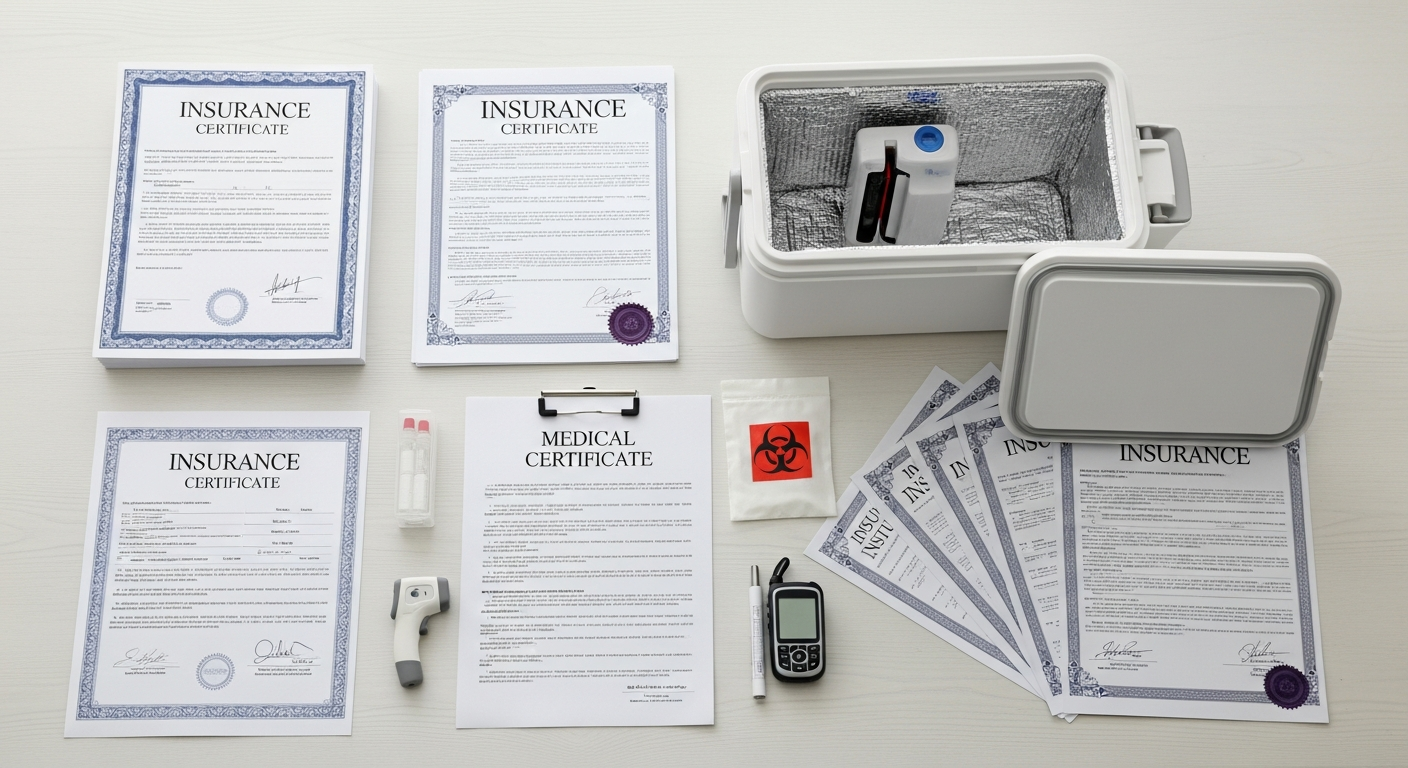
Point 5: Insurance. Request current certificates of insurance and read the limits. Commercial auto liability should cover the vehicles that actually carry your specimens, including hired and non-owned autos. The line most often missing is cargo coverage that includes spoilage or refrigeration breakdown; compare its limit against your largest single shipment, which for a cell therapy batch can exceed a standard cargo limit many times over. Our article on medical courier insurance coverage requirements explains each line.
Documents to request and actually read:
- A redacted sample driver file with background check date, motor vehicle record and dated training certificates.
- The written exposure control plan and spill procedure required by the OSHA bloodborne pathogens standard.
- A signed business associate agreement with breach notification within a stated number of days.
- Certificates of insurance for auto, general liability, cargo and workers’ compensation, with limits and expiration dates.
- The written subcontracting policy, including whether any delivery is ever handed to a gig platform driver.
3. Operations and Technology: How Orders Actually Get Delivered
Point 6: Dispatch model and coverage. A courier that runs 24/7/365 with a live dispatcher can take a 3 AM STAT and assign it in minutes; one that forwards the night line to a cell phone cannot promise that. The difference on assignment is between a dispatcher working a phone list and software that ranks available drivers by position, current load and deadline. A floating driver network spread across the region usually beats a static fleet parked at one depot for on-demand work.
Point 7: Tracking, proof of delivery and chain of custody. GPS tracking your staff can see, geofenced photos at pickup and delivery, electronic signature, specimen counts and timestamps are the components. The test is whether they combine into a proof-of-delivery record you can export and attach to a chain-of-custody file without retyping. Place a test order in the customer portal yourself and time it; a well-designed portal takes under a minute.
Point 8: Temperature capability and validation. A courier should be able to name its tiers, typically ambient, refrigerated at 2 to 8 C, frozen, dry ice and cryogenic in liquid nitrogen dry shippers. The more revealing question is the excursion procedure: when a logger shows 9 C on a refrigerated load, who is notified, within how many minutes, and who decides whether the specimen is still usable. Our page on temperature-controlled medical transport maps the tiers to product types.
Tests to run during the vendor demonstration:
- Place a test order yourself and time it, then cancel it and see how the cancellation reaches dispatch.
- Watch a live delivery on the tracking map, including the geofence trigger at the destination.
- Download a completed proof-of-delivery record and check timestamps, photos, signature and specimen count.
- Call the dispatch number outside business hours and record how long it takes to reach a person.
- Ask how a driver is selected for a STAT order and what happens when that driver is unavailable.
4. Performance Measurement, Pricing Transparency and Red Flags
Point 9: SLA and KPI definitions. An on-time figure means nothing without the definition behind it. Insist on a written definition per tier: STAT in minutes from order acceptance to delivery, same-day against a stated cutoff, routes against a window at each stop. Agree on the measurement source, the courier’s system with your own read access, and on a monthly scorecard with exception reports within a day and a root cause for every missed window. Our article on medical courier SLAs and KPIs gives definitions you can paste into a contract.
Point 10: Pricing structure. Medical courier pricing usually combines a base or pickup fee, a mileage rate and an urgency multiplier, with accessorial charges for after-hours and weekend service, waiting time beyond a grace period, cancellations, tolls and sometimes fuel. Ask for a rate card that shows every line, then run your 90-day history through it rather than comparing headline rates. Our page on medical courier pricing explains the components.
Point 11: Red flags. Certain findings should end an evaluation. The most common is quiet subcontracting: a vendor that accepts your order and posts it to a load board or a gig delivery platform, so the person carrying your specimens has none of the screening you were shown. Our analysis of medical courier versus gig economy delivery explains what that does to chain of custody and HIPAA exposure.
Red flags that should end the evaluation:
- The vendor cannot produce a completed proof-of-delivery record from a real delivery during the meeting.
- Deliveries are subcontracted to gig platforms or load boards without your written approval.
- No business associate agreement, or a BAA with no breach notification timeline.
- No written temperature excursion procedure, or one that depends on the driver noticing.
- Reluctance to run a paid pilot with defined exit criteria.
5. Pilot Design and Contracting: Prove It Before You Choose a Medical Courier
Point 12: The pilot. No amount of documentation substitutes for 30 to 60 days of real orders. Scope it to one draw-site route with its STAT overflow. Baseline the metrics from your own records, set success thresholds per tier in writing before day one, and review weekly with a named owner on each side. Build in deliberate stress events, because a pilot that only sees Tuesday mornings says nothing about Saturday night. A multi-site outreach program in Fairfield County, Connecticut should pilot its longest route and its most time-sensitive STAT lane, not its easiest.
The contract should encode what the pilot proved: a 12-month initial term with termination for cause on 30 to 60 days’ notice, a rate lock with any escalation formula stated, the BAA and certificates of insurance attached as exhibits, a prohibition on subcontracting without written consent, the KPI definitions from Point 9 with service credits, and an explicit statement that you own the delivery records and can export them at any time. Then transition in stages, keeping the incumbent until the new courier has carried a full month at target volume.
Elements of a pilot that produces a decision:
- A fixed duration of 30 to 60 days with a start date, a weekly review and a named owner on both sides.
- Baseline numbers from your own records so the pilot measures change rather than self-report.
- Success thresholds agreed in writing before day one, per service tier.
- At least three deliberate stress events: an after-hours STAT, a weekend pickup and a mid-route cancellation.
- Invoice reconciliation against the rate card for every pilot delivery.
Key Takeaways
To choose a medical courier well, evaluate evidence rather than claims. Twelve points, five stages and a pilot that stresses the vendor where your operation is most exposed will separate a courier that can carry your specimens at 2 AM from one that can only describe doing so.
- Build the demand profile and regulatory scope from your own data before talking to vendors.
- Treat training records, a signed BAA and certificates of insurance as pass-fail gates, not scoring items.
- Test dispatch, tracking, proof of delivery and the excursion procedure live, not in slides.
- Define on-time per tier in writing and model the full rate card against 90 days of real orders.
- Pilot for 30 to 60 days with baselines, thresholds and stress events, then write the results into the contract.
If you are building an evaluation like this for a laboratory, hospital, pharmacy or biotech operation in the Northeast, request a demo of the carGO Health platform and run the Section 3 tests against it.
Frequently Asked Questions
What is the most important factor when choosing a medical courier?
Evidence over claims. What predicts performance is whether a vendor can show you driver training records, a signed business associate agreement, a completed proof-of-delivery export and a written temperature excursion procedure, then reproduce them during a 30 to 60 day pilot on your real orders.
Does a medical courier need a business associate agreement under HIPAA?
In most cases, yes. HHS describes the conduit exception as narrow and limited to entities that transport information without accessing it. A courier whose drivers handle requisitions and labels carrying patient names generally does not qualify, so covered entities execute a BAA covering breach notification, subcontractor flow-down and device security.
What training should medical courier drivers have?
At minimum: HIPAA privacy training on what may be done with requisitions, labels and photos; OSHA bloodborne pathogens training at assignment and annually under 29 CFR 1910.1030; and DOT hazardous materials training under 49 CFR 172.704 for UN3373 specimens and dry ice, refreshed at least every three years. Ask for the records with dates, not a description of the program.
How long should a medical courier pilot last?
Thirty to sixty days is long enough to see weekend, after-hours and month-end volume while keeping the incumbent in place. Scope it to one route family or one site with real STAT overflow, baseline your metrics beforehand, set written thresholds per tier, review weekly, and include deliberate stress events.
What insurance should a medical courier carry?
Commercial auto liability covering the vehicles that actually carry specimens, including hired and non-owned autos; general liability; workers’ compensation; cyber liability; and cargo coverage that explicitly includes spoilage or refrigeration breakdown. Request current certificates of insurance, compare the cargo limit against your largest single shipment, and ask to be named as an additional insured.
Related Resources